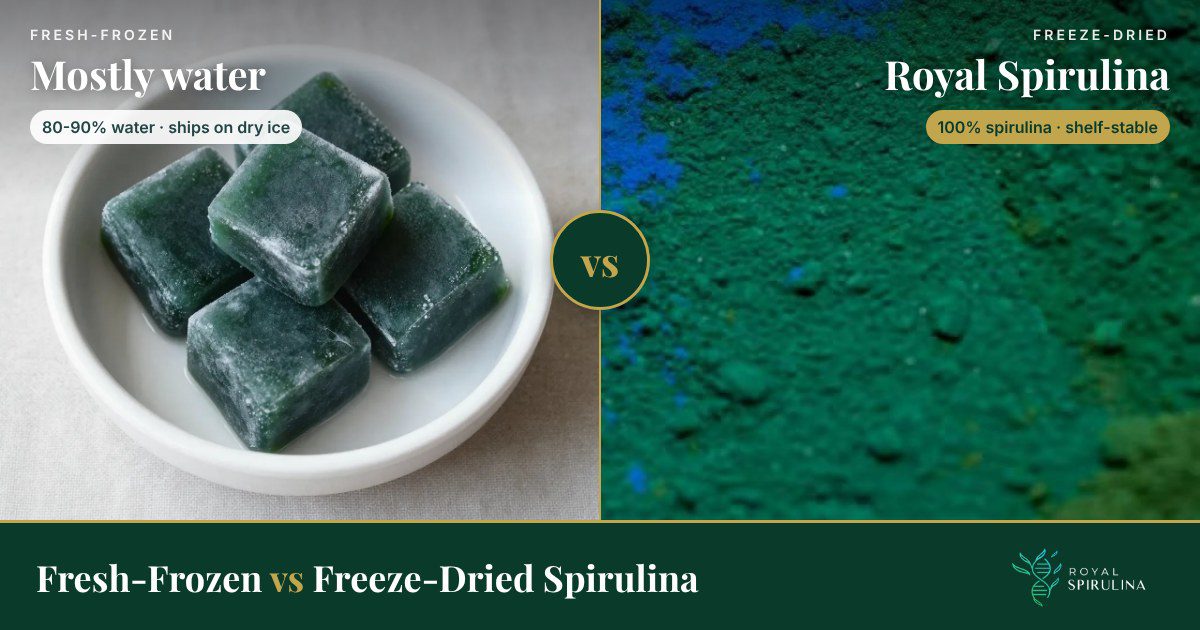
Fresh-frozen spirulina is having a moment. You’ll see it sold as frozen cubes or pods, shipped on dry ice, and marketed as the “real” spirulina, with every powder dismissed as a compromise.
Here’s the problem with that pitch: it lumps every powder together. A cheap spray-dried powder blasted at 150 to 200°C and a freeze-dried powder dried below freezing under vacuum are not the same product. Not even close.
So let’s put fresh-frozen and freeze-dried side by side and look at what actually happens to the spirulina, what you’re paying for, and what ends up in your glass.
The short answer
- Fresh-frozen spirulina is mostly water. Fresh spirulina paste typically runs around 80 to 90% moisture, so most of what you pay for, freeze, and ship on dry ice is water.
- Freezing and thawing breaks spirulina cells. Repeated freeze-thaw cycles are a standard lab method for cracking spirulina open to extract phycocyanin.
- Once thawed, fresh spirulina is perishable. Published shelf-life data puts unfrozen fresh biomass at about 8 days at room temperature and about 36 days refrigerated.
- Freeze-drying freezes once and never thaws. The water leaves as vapor under vacuum, so the cells are locked in place and the powder stays shelf-stable for years.
- Spray-dried powder is the real compromise. High heat is what damages spirulina, not the fact that it’s a powder.
Fresh-Frozen vs Freeze-Dried vs Spray-Dried: Quick Comparison
| Factor | Fresh-Frozen | Freeze-Dried | Spray-Dried |
|---|---|---|---|
| Water content | High (roughly 80-90%) | Very low | Very low |
| Spirulina per gram | Low (mostly water) | Highest (about 5-7x fresh) | High, but heat-damaged |
| Processing temperature | Frozen, then thawed at home | Below freezing, under vacuum | 150-200°C hot air |
| Freeze-thaw stress on cells | Yes (every thaw, plus any thaw in transit) | No (never thaws to liquid) | No, but heat does the damage |
| Shelf life | Freezer only; days to weeks once thawed | Years, sealed, in the pantry | Long, but nutrients already reduced |
| Shipping | Dry ice, insulated box, cold chain | Regular mail in a sealed bag | Regular mail |
| Travel and storage | Needs freezer space | Fits in a bag, a drawer, a suitcase | Easy |
| Dosing | Fixed cube or pod size | Any amount, by the spoon | Any amount |
What Fresh-Frozen Gets Right
Let’s be fair. Fresh-frozen spirulina has real strengths. It skips high-heat drying entirely, which is a big step up from cheap spray-dried powder. It has a mild taste and a smooth texture that blends easily into smoothies. And a 2026 shelf-life study in the Journal of Food Science found that fresh spirulina’s phycocyanin, chlorophyll, and carotenoid levels held steady over 36 days of cold storage (PMID: 42178860; DOI: 10.1111/1750-3841.71149).
If the only choice were fresh-frozen or cheap spray-dried powder, fresh-frozen wins. But that’s not the only choice.
Problem 1: You’re Paying to Freeze and Ship Water
Fresh spirulina is harvested as a wet paste. Even after pressing, it typically runs around 80 to 90% water. The same 2026 study notes that this high moisture content is exactly what makes fresh spirulina “highly perishable” (PMID: 42178860).
Do the math. If a fresh cube is 85% water, only 15% of it is spirulina. Gram for gram, freeze-dried powder delivers roughly 5 to 7 times more actual spirulina. That’s the same protein, iron, chlorophyll, and phycocyanin, just without the water.
And all that water has to be frozen, packed in dry ice, shipped in an insulated box, and stored in your freezer. You’re paying for every step.
Problem 2: Freezing and Thawing Breaks Spirulina Cells
This is the part nobody selling frozen spirulina talks about.
Spirulina doesn’t have a hard cell wall like chlorella. It has a delicate protein membrane. When water inside the cell freezes, ice crystals form and the membrane ruptures. When it thaws, the contents leak out.
That’s not a theory. It’s how labs deliberately break spirulina open. Repeated freeze-thaw cycles are one of the standard physical methods researchers use to crack spirulina cells and pull out phycocyanin:
- A 2024 study in Archives of Microbiology compared ultrasonication, homogenization, and freeze-thaw cycles for breaking open spirulina cells. Freeze-thaw with an acetate buffer produced the highest phycocyanin release of the methods tested (PMID: 38735006; DOI: 10.1007/s00203-024-03968-8).
- A 2026 study in Food Chemistry: X used freeze-thaw extraction to make phycocyanin powder from spirulina and found 12 cycles to be optimal for pulling the pigment out of the cells (PMID: 42819745; DOI: 10.1016/j.fochx.2026.104423).
- A 2025 study in the Journal of Food Science lists freeze-thaw cycles alongside ultrasound as cell disruption techniques for extracting food-grade phycocyanin (PMID: 40344581; DOI: 10.1111/1750-3841.70240).
One freeze isn’t the same as twelve lab cycles. But a frozen product has to survive the farm freezer, the truck, the dry ice running low, your porch, and your kitchen. Every partial thaw and refreeze along the way is another cycle on a cell that was never built for it.
Once those cells open up, the phycocyanin is out in the water, exposed to air, light, and warmth. That’s where it starts to break down.
Problem 3: Once It Thaws, the Clock Starts
The 2026 shelf-life study tracked fresh spirulina at 4°C, 10°C, and 20°C. Here’s what the researchers found (PMID: 42178860):
- The cells broke down on their own. The study reported temperature-dependent autolysis, meaning the spirulina cells broke down during storage and released phycocyanin into the liquid. The color shifted visibly.
- Bacteria climbed steadily. Microbial counts rose with time and temperature until the spirulina developed an off odor.
- Shelf life was short. Estimated shelf life was about 8 days at room temperature, 20 days at 10°C, and 36 days at 4°C.
- Fats oxidized. Secondary lipid oxidation products rose by 83.7 to 91.1% over the study period.
Freezing pauses that clock. Thawing restarts it. So the real question with any fresh-frozen product is simple: how many times did it partly thaw before it reached you?
Problem 4: The Cold Chain Is Fragile
Fresh-frozen spirulina only works if it stays frozen from harvest to your blender. That means dry ice, insulated packaging, fast shipping, and someone home to put it away.
A delayed truck, a hot loading dock, or a box left on the porch all break that chain. And you can’t always tell from looking at a refrozen cube.
Freeze-dried spirulina doesn’t have this problem. It ships in a sealed bag through regular mail and sits in your pantry. No dry ice. No freezer space. No guessing.
Why Freeze-Drying Is Different
Here’s what people miss: freeze-drying also starts with freezing. The difference is what happens next.
In freeze-drying (lyophilization), the spirulina is frozen once and placed under a vacuum. The ice turns straight into vapor without ever melting back into liquid water. That process is called sublimation. Because the spirulina never thaws, there’s no liquid for the contents to leak into, no thaw-refreeze cycling, and no heat damage.
What’s left is pure spirulina with almost no water, locked in place and shelf-stable.
The research backs this up. A 2025 study in Molecules found freeze-dried spirulina extract reached 67 to 78% encapsulation efficiency for phycocyanin compared to 38 to 42% for spray-dried (PMID: 40142077; DOI: 10.3390/molecules30061303). A 2020 study in Food Technology and Biotechnology reported about 99% encapsulation efficiency for freeze-dried phycocyanin with preserved antioxidant activity (PMID: 33505205; DOI: 10.17113/ftb.58.04.20.6622).
For a full breakdown of heat drying vs. freeze-drying, see our freeze-dried vs spray-dried spirulina comparison.
“Powder Is a Compromise.” Is It?
You’ll hear that all spirulina powder is a compromise. That’s true of spray-dried powder. Hot air at 150 to 200°C damages phycocyanin, oxidizes fats, and turns spirulina from vivid blue-green to dull olive or brown.
But calling freeze-dried powder a compromise because it’s a powder is like calling frozen berries a compromise because they’re not on the vine. The format isn’t the issue. The process is.
The honest ranking looks like this:
- Freeze-dried: no heat, no thaw cycling, no water weight, shelf-stable.
- Fresh-frozen: no heat, but mostly water, cell damage from freezing and thawing, and a fragile cold chain.
- Spray-dried: cheap and convenient, but heat-damaged before it ever reaches you.
How to Judge Any Spirulina in 60 Seconds
Whatever format you buy, check these:
- Processing method on the label. If it doesn’t say freeze-dried, assume spray-dried.
- Color. Good spirulina is a vivid deep green with blue-green tones. Brown, olive, or gray means damage.
- Smell. Clean, fresh, and mild. A sharp, ammonia, or urine-like smell is a red flag.
- Lab results you can actually see. Look for a certificate of analysis (COA) covering microcystins, heavy metals, and microbes, posted where you can read it, not just “available on request.”
- How it’s grown. Controlled growing systems reduce the risk of contamination from open ponds.
- Price per gram of actual spirulina. For frozen products, divide by the water content before you compare.
Royal Spirulina: Freeze-Dried, Never Thawed, Never Heated
Royal Spirulina is freeze-dried. Our best batches go straight from collection into the freeze dryer. No spray-drying. No high heat. No thaw cycles.
- Grown in controlled bioreactors for consistency batch to batch.
- Washed gently. Spirulina’s membrane is delicate, so our washing process takes extra steps to keep the cells from bursting.
- Checked under the microscope before every batch is processed.
- Lab results posted publicly. Our COA and purity analysis are on the product page for anyone to read.
- 100% spirulina. No fillers, no water weight, no dry ice. Ships in a sealed bag.
Don’t just take our word for it. When Goodnature, the commercial cold-press juicer company, compared 8 spirulina brands side by side on color, smell, and taste, Royal Spirulina scored a perfect 10 out of 10. In their words: “The best spirulina I could find (by far) is from a brand called Royal Spirulina.” (Read the Goodnature comparison.)
Want to see how we stack up? Read our guide to the best spirulina powder or try a 100g bag of freeze-dried spirulina.
Frequently Asked Questions
Is fresh spirulina better than freeze-dried?
Not gram for gram. Fresh spirulina is roughly 80 to 90% water, so freeze-dried powder delivers about 5 to 7 times more actual spirulina per gram. Fresh-frozen also goes through freezing and thawing, which ruptures spirulina’s delicate cells. Freeze-drying freezes once and removes the water as vapor, so the spirulina never thaws.
Does freezing spirulina damage it?
Freezing and thawing breaks spirulina cells. Repeated freeze-thaw cycles are a standard lab method for rupturing spirulina to extract phycocyanin. One careful freeze does less damage than many cycles, but any partial thaw during shipping or storage adds stress. Freeze-drying avoids this because the ice turns to vapor without melting.
How long does fresh spirulina last once thawed?
A 2026 study estimated the shelf life of fresh spirulina biomass at about 8 days at room temperature, 20 days at 10°C, and 36 days at 4°C, based on bacterial growth and off odor. The cells also broke down on their own over time, releasing phycocyanin into the liquid.
Is freeze-dried spirulina the same as spray-dried?
No. Spray-drying uses hot air at roughly 150 to 200°C, which damages phycocyanin and oxidizes fats. Freeze-drying works below freezing under vacuum with no heat damage. Research shows freeze-drying retains far more phycocyanin than spray-drying.
Why is freeze-dried spirulina more expensive than spray-dried?
Freeze-drying is slow and energy-intensive. A batch can take many hours in the freeze dryer, while spray-drying turns liquid into powder in seconds. You’re paying for a gentler process that keeps more of the nutrition intact.
How much freeze-dried spirulina equals a fresh spirulina cube?
It depends on the cube’s size and water content. As a rule of thumb, divide the fresh weight by 5 to 7. A 10g fresh portion at 85% water contains about 1.5g of actual spirulina, about half a teaspoon of freeze-dried powder.
What’s the best way to take freeze-dried spirulina?
Stir it into juice, blend it into a smoothie, or mix it with water and lemon. See our guide on how to use spirulina powder for more ideas.
Scientific References
- Giannoglou M, Andreou V, Thanou I, Markou G, Katsaros G. Fresh Spirulina biomass: quality deterioration, microbiological stability, and shelf-life assessment. Journal of Food Science. 2026;91(5):e71149. PMID: 42178860. DOI: 10.1111/1750-3841.71149.
- Athiyappan KD, Chaudhuri R, Balasubramanian P. Enhancing phycocyanin yield from Spirulina sp. under salt stress using various extraction methods. Archives of Microbiology. 2024;206(6):258. PMID: 38735006. DOI: 10.1007/s00203-024-03968-8.
- Nguyen DT, Dang TT, Nguyen QD, et al. Preparation of phycocyanin-rich powder from algae using freeze/thaw/osmotic treatment coupled with Refractance Window drying and its application as a colorant in set-type yoghurt. Food Chemistry: X. 2026;39:104423. PMID: 42819745. DOI: 10.1016/j.fochx.2026.104423.
- Cortés Meneses L, Castro JDL, Murillo Vega F, et al. Development of a methodology for the extraction of potential food-grade phycocyanin from Arthrospira maxima. Journal of Food Science. 2025;90(5):e70240. PMID: 40344581. DOI: 10.1111/1750-3841.70240.
- Navikaitė-Šnipaitienė V, Liudvinavičiūtė D, Rutkaitė R, et al. Antioxidant capacity and thermal stability of Arthrospira extract encapsulated in starch sodium octenyl succinate with freeze-, spray-, and nanospray-drying. Molecules. 2025;30(6):1303. PMID: 40142077. DOI: 10.3390/molecules30061303.
- Pan-Utai W, Iamtham S. Enhanced microencapsulation of C-phycocyanin from Arthrospira by freeze-drying with different wall materials. Food Technology and Biotechnology. 2020;58(4):423-432. PMID: 33505205. DOI: 10.17113/ftb.58.04.20.6622.
Related Reading
Freeze-Dried vs Spray-Dried Spirulina: How processing temperature affects phycocyanin, enzymes, and fats.
Best Spirulina Powder: What to look for and how Royal Spirulina compares.
Spirulina Powder vs Tablets vs Capsules: Why the form you buy matters.
Why Juice Bars Are Switching to Freeze-Dried Spirulina: What the pros are choosing and why.
Blue Spirulina vs Green Spirulina: Whole food vs extracted pigment.
What Does Spirulina Taste Like?: Why quality changes the flavor.