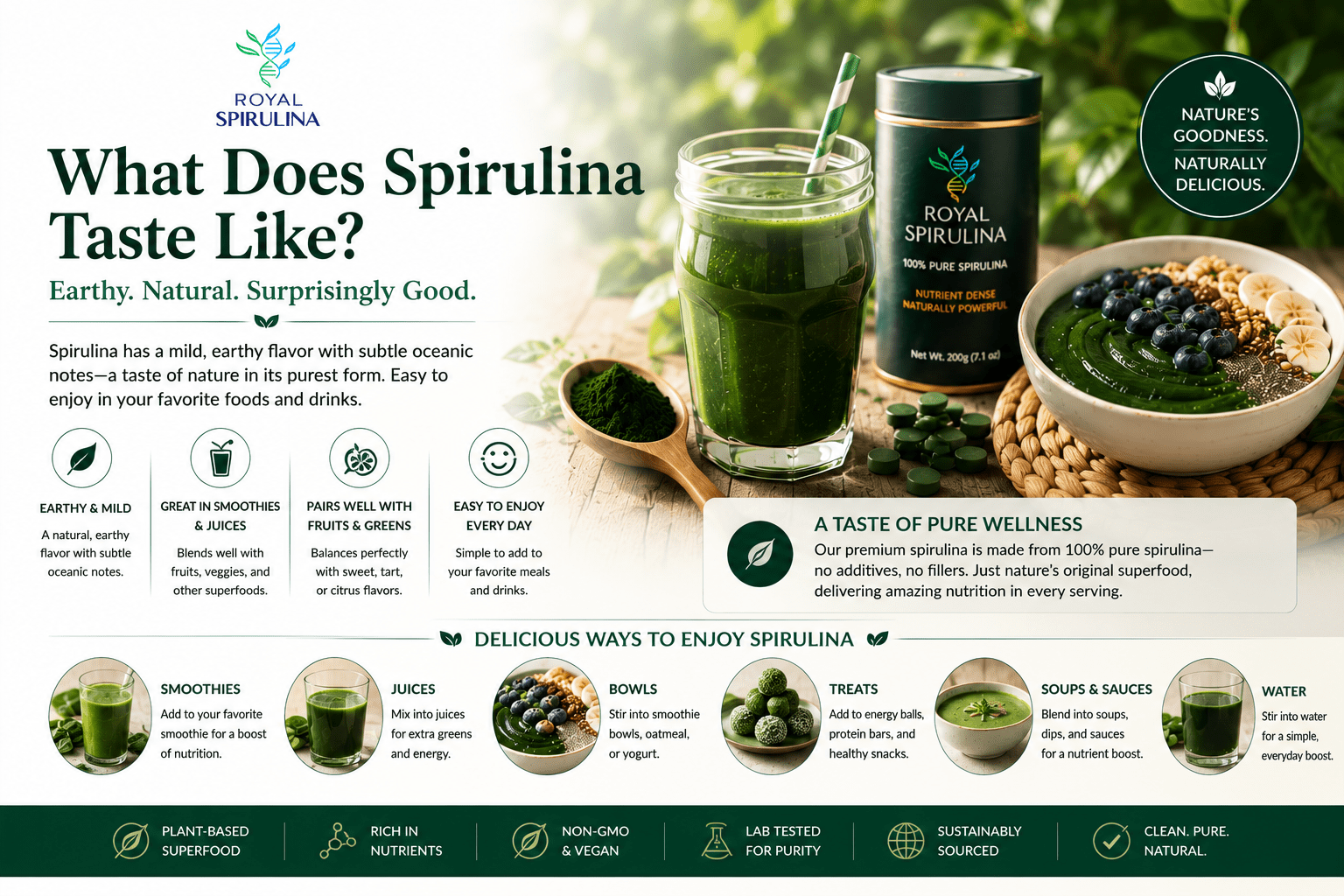
What Does Spirulina Taste Like? (And How to Make It Taste Better)
Let’s be honest: spirulina’s taste is the number one reason people stop taking it. You’ve read about the incredible nutritional profile — 55-70% protein, essential fatty acids, phycocyanin, chlorophyll — and you’re ready to make it part of your daily routine. Then you mix a teaspoon into water, take a sip, and wonder what on earth you just put in your mouth.
You’re not alone. The taste of spirulina is a genuine barrier for many people, and it’s one of the most common questions we receive at Royal Spirulina. But here’s the good news: not all spirulina tastes the same, the science explains exactly why some spirulina tastes worse than others, and there are proven strategies to make it not just tolerable — but genuinely enjoyable.
In this guide, we’ll break down exactly what spirulina tastes like, the chemistry behind its unique flavor, why freeze-dried spirulina like Royal Spirulina tastes significantly milder than cheap spray-dried imports, and over a dozen practical ways to incorporate it into foods you already love.
What Does Spirulina Actually Taste Like?
Describing spirulina’s flavor to someone who has never tried it is a bit like describing the ocean to someone who has never been — there’s nothing quite like it. Most people describe spirulina’s taste as a combination of:
- Earthy — like fresh soil or wet moss after rain
- Seaweed-like — a mild marine quality, though spirulina is actually a freshwater organism
- Grassy — similar to wheatgrass or fresh-cut lawn, but deeper
- Slightly salty — a natural mineral saltiness that some find pleasant
- Faintly fishy — especially in lower-quality products that have been improperly dried
The intensity of these flavors varies enormously depending on quality. Freeze-dried spirulina (like Royal Spirulina) has a notably milder, cleaner taste — more of a gentle earthiness with subtle green notes. In contrast, spray-dried Chinese imports tend to be much more pungent, with stronger fishy and pond-like off-flavors that make many people gag.
The Science Behind Spirulina’s Flavor
A landmark 2024 study published in Food Chemistry identified 90 distinct volatile odorant compounds in spirulina at different processing stages. These compounds belong to several chemical families — aldehydes, ketones, terpenoids, and heterocyclic compounds — each contributing a different dimension to the overall flavor profile.
The key finding? The drying method dramatically influences which compounds dominate. Spray drying at high temperatures (150-200°C) actively promotes the formation of additional aldehydes, heterocyclic compounds, and terpenoids — essentially creating MORE off-flavor compounds that don’t exist in the fresh biomass. This is why processing method matters so much for taste.
A 2022 study in Scientific Reports confirmed that Arthrospira platensis (spirulina) has the highest abundance and chemical diversity of volatile organic compounds among seven microalgae and cyanobacteria strains tested. Its profile is dominated by branched hydrocarbons, aldehydes, ketones, and alcohols — a complex bouquet that explains why the taste is so distinctive.
Spirulina Flavor Compounds and What They Taste/Smell Like
| Compound | Flavor/Aroma Description | Also Found In |
|---|---|---|
| β-Cyclocitral | Earthy, tobacco-like, woody | Tobacco leaves, saffron |
| Nonanal | Green, citrusy, slightly fatty | Citrus peels, rose oil |
| 1-Octen-3-ol | Mushroom-like, fishy, damp | Mushrooms, lavender |
| Hexanal | Grassy, green, fresh-cut | Fresh cut grass, green apples |
| β-Ionone | Floral, violet, berry-like | Violets, raspberries, carrots |
| D-Limonene | Citrusy, fresh, bright | Orange peel, lemon zest |
| Decanal | Waxy, orange-peel, soapy | Citrus fruits, coriander |
| Isophorone | Minty, camphor-like, peppery | Saffron, certain essential oils |
| Dimethyl sulfide | Marine, seaweed, ocean-like | Cooked corn, seaweed, beer |
| 2-Pentylfuran | Beany, green, vegetal | Soybeans, green beans |
Data synthesized from volatile compound analyses of Arthrospira platensis (References 1, 2, 8).
Why Processing Method Affects Taste
If you’ve tried spirulina before and hated it, there’s a very good chance you were tasting the effects of spray drying — not spirulina itself.
Here’s what happens at a chemical level: when spirulina biomass is subjected to spray drying at temperatures of 150-200°C, the extreme heat triggers Maillard reactions and lipid oxidation. According to the 2024 Food Chemistry study, this process actively promotes the formation of aldehydes, heterocyclic compounds, and terpenoids — the very compound classes responsible for off-flavors like fishiness, staleness, and that “pond water” quality people complain about.
The study found that spray-dried powders had stronger grassy odor, roasted odor, and marine odor compared to the raw biomass. Wet spirulina mud presented stronger earthy and fishy odors, which means spray drying doesn’t eliminate these — it transforms them into different (often worse) off-flavors while adding new ones.
Freeze-Drying: Preserving Natural Mildness
Freeze drying (lyophilization) works at temperatures far below those that trigger off-flavor formation. By sublimating water directly from ice to vapor under vacuum, freeze drying preserves the spirulina’s natural, mild flavor profile without creating the harsh aldehydes and heterocyclic compounds that make spray-dried products taste unpleasant.
This is exactly why Royal Spirulina is exclusively freeze-dried. The result is a noticeably cleaner, milder taste — more of a gentle green earthiness rather than the overwhelming fishy, pond-like flavor associated with mass-market spray-dried imports from China. Many customers who previously couldn’t stand spirulina tell us they’re surprised at how much milder Royal Spirulina tastes compared to products they’d tried before.
How to Make Spirulina Taste Better
Even with a high-quality freeze-dried spirulina, you may still want strategies to fully incorporate it into foods and drinks you enjoy. Here are the most effective approaches, backed by both food science and practical experience:
1. Blend It Into Smoothies (Best Method)
This is the gold standard for spirulina taste-masking, and for good reason. The combination of natural sugars, fats, and strong fruit flavors in a smoothie overwhelms spirulina’s relatively mild earthy notes. Research on spirulina in food products shows that fruit-based vehicles are the most effective at masking spirulina’s distinctive taste.
Best smoothie combinations:
- Banana + peanut butter + cocoa + spirulina (the chocolate masks everything)
- Mango + pineapple + coconut milk + spirulina (tropical sweetness dominates)
- Mixed berries + banana + oat milk + spirulina (berry flavors hide green notes)
- Banana + vanilla protein powder + almond milk + spirulina
2. Combine with Citrus Juice
Acidic environments help neutralize the alkaline, earthy compounds in spirulina. The natural d-limonene already present in spirulina actually harmonizes well with additional citrus. Try stirring 1 teaspoon into fresh orange juice or lemonade — the acidity cuts through the earthiness remarkably well.
3. Use Tropical Fruits as Your Vehicle
Banana, mango, and pineapple are the three strongest spirulina taste-maskers in the fruit world. Banana works particularly well because its creamy texture coats the palate and its natural sweetness competes directly with spirulina’s earthy flavor receptors. Ripe banana is better than unripe for this purpose.
4. Chocolate and Cacao
Chocolate is remarkably effective at masking green, earthy flavors — this is why it’s used in so many greens supplements. The roasted, bitter-sweet compounds in cacao directly compete with spirulina’s volatile compounds for the same olfactory receptors. Add 1-2 tablespoons of cacao powder to any spirulina smoothie and the green flavor virtually disappears.
5. Savory Foods (Embrace the Earthiness)
Instead of fighting spirulina’s flavor, lean into it. Research published in Foods found that at concentrations up to 2.5%, spirulina in bread was well-accepted by consumers, with panelists actually emphasizing the salty flavor as a pleasant feature. The acceptability index was consistently above 72%.
Savory applications that work beautifully:
- Guacamole — spirulina’s earthiness blends seamlessly with avocado
- Hummus — the tahini and garlic dominate while spirulina adds color and nutrition
- Soups and stews — stir in after cooking (don’t boil it)
- Salad dressings — especially green goddess or tahini-based
- Pesto — the basil and garlic completely mask spirulina
6. Energy Balls and Bites
No-bake energy balls are perfect spirulina vehicles. Dates, nut butters, oats, and cocoa powder create a dense, sweet, rich matrix that buries spirulina’s flavor under layers of more dominant tastes and textures. Plus, you can make a batch on Sunday and have your daily spirulina pre-portioned for the week.
7. Frozen Treats
Cold temperatures naturally suppress our perception of flavors — this is why ice cream needs so much sugar to taste sweet. Use this to your advantage by adding spirulina to homemade nice cream (frozen banana blended smooth), popsicles, or smoothie bowls topped with granola. The freezing temperatures mute spirulina’s earthy notes significantly.
8. The Curcumin Trick (Science-Backed)
A fascinating 2025 study found that curcumin (the active compound in turmeric) directly reduces spirulina’s fishy odorants through competitive inhibition with hexanal and 1-octen-3-ol — the two key compounds responsible for the “fishy” smell. Adding a pinch of turmeric to spirulina preparations isn’t just good for anti-inflammatory synergy; it physically blocks the worst off-flavor compounds from reaching your nose.
Quick Recipe Ideas to Mask Spirulina Taste
| Recipe | Key Ingredients | Spirulina Amount | Taste-Masking Rating |
|---|---|---|---|
| Chocolate Peanut Butter Smoothie | Banana, cacao, peanut butter, oat milk | 1-2 tsp | ★★★★★ |
| Tropical Mango Smoothie | Mango, pineapple, coconut milk, lime | 1 tsp | ★★★★★ |
| Spirulina Energy Balls | Dates, almonds, cacao, coconut, oats | 2 tsp per batch (12 balls) | ★★★★★ |
| Green Guacamole | Avocado, lime, cilantro, garlic, jalapeño | 1 tsp per 2 avocados | ★★★★☆ |
| Banana Nice Cream | Frozen bananas, vanilla, maple syrup | 1 tsp per 2 bananas | ★★★★☆ |
| Spirulina Pesto Pasta | Basil, pine nuts, garlic, olive oil, parmesan | 1 tsp per serving | ★★★★☆ |
| Citrus Spirulina Shot | Fresh OJ, lemon, ginger, turmeric | 1 tsp in 4 oz juice | ★★★☆☆ |
| Spirulina Hummus | Chickpeas, tahini, lemon, garlic, olive oil | 1-2 tsp per batch | ★★★★☆ |
| Berry Spirulina Popsicles | Mixed berries, yogurt, honey, lime | 1 tsp per 4 popsicles | ★★★★☆ |
| Turmeric-Spirulina Latte | Warm (not hot) oat milk, turmeric, cinnamon, honey | ½ tsp | ★★★☆☆ |
Ratings based on how effectively the recipe masks spirulina’s natural flavor. ★★★★★ = completely undetectable; ★★★☆☆ = noticeable but pleasant.
Foods That DON’T Work Well with Spirulina
Not every food combination is a winner. Save yourself the unpleasant experience and avoid these:
- Plain water — This is the worst possible vehicle. Without any competing flavors, fats, or sugars to buffer it, you get the full unmasked spirulina experience. The powder doesn’t dissolve well either, leaving a gritty, algae-flavored slurry that clings to your mouth.
- Hot beverages (coffee, tea, hot water) — Heat above 60°C begins to degrade spirulina’s phycocyanin and other heat-sensitive nutrients, AND it volatilizes more odor compounds, making the taste actively worse. The steam carries those earthy, marine aromatics straight into your nose. If you want a warm drink, let it cool to lukewarm first.
- Dairy milk alone — Unlike plant milks with added sugars and flavors, plain cow’s milk doesn’t have strong enough competing flavors. The result is an unappealing greenish milk with a distinct pond-like taste that’s hard to finish.
- Delicate-flavored dishes — Light salads, mild white fish, plain rice, or subtle desserts like panna cotta will be completely overwhelmed by spirulina. The dish doesn’t mask the spirulina; the spirulina overpowers the dish.
- Carbonated beverages — The fizz amplifies bitter and earthy notes while the carbonation creates an unpleasant foaming reaction with the powder.
Does Spirulina Quality Affect Taste?
Absolutely — and this cannot be overstated. The difference between high-quality and low-quality spirulina is not subtle. It’s the difference between fresh sushi and gas-station sushi.
Here are the factors that determine how your spirulina tastes:
Freshness matters. Spirulina’s volatile compounds continue to oxidize after production. Older spirulina develops increasingly rancid, fishy flavors as its fatty acids (particularly gamma-linolenic acid) break down. Fresh spirulina tastes greener and cleaner; old spirulina tastes fishier and more pungent.
Drying method is critical. As we’ve discussed, spray drying at extreme temperatures creates additional off-flavor compounds that don’t exist in properly freeze-dried spirulina. A 2025 chemical characterization study confirmed that spirulina’s odor profile includes hydrocarbons, heterocyclic compounds, aldehydes, thiocyanates, and esters — and the balance between these is heavily influenced by processing conditions.
Growing conditions play a role. Spirulina grown in controlled environments with clean water and optimal nutrition develops a cleaner flavor profile. Mass-produced spirulina from open ponds may develop off-flavors from environmental contaminants, competing microorganisms, or suboptimal growing conditions.
Storage and packaging. Exposure to light, oxygen, and moisture accelerates flavor degradation. Properly sealed, opaque packaging is essential for maintaining a mild taste profile over time.
Royal Spirulina addresses all of these factors: freeze-dried for minimal off-flavor formation, freshly produced in small batches, grown in controlled conditions, and packaged to preserve quality. This is why customers consistently report it tastes milder and more palatable than the spray-dried spirulina powders commonly imported from China.
Frequently Asked Questions
Why does spirulina taste so bad to some people?
Spirulina contains 90+ volatile organic compounds including aldehydes, ketones, and terpenoids that trigger earthy, grassy, and marine flavor perceptions. Some people are genetically more sensitive to certain bitter and earthy compounds (similar to how some people taste cilantro as soapy). Additionally, low-quality spray-dried spirulina has significantly more off-flavor compounds than freeze-dried varieties, so many people’s first experience is with a product that tastes far worse than it needs to.
Does spirulina taste like fish?
Fresh, high-quality freeze-dried spirulina should NOT taste strongly fishy. The fishy flavor comes primarily from two compounds: hexanal and 1-octen-3-ol. These are more concentrated in improperly stored spirulina and in spray-dried products where heat processing promotes their formation. If your spirulina tastes very fishy, it may be old, poorly processed, or both. Royal Spirulina’s freeze-drying process minimizes these compounds, resulting in a cleaner, more earthy (rather than fishy) flavor.
What is the best way to take spirulina if you hate the taste?
A chocolate smoothie is hands-down the most effective taste-masking method. Blend 1 teaspoon spirulina with a frozen banana, 1 tablespoon cacao powder, 1 tablespoon peanut butter, and a cup of oat milk. The combination of fat, sugar, chocolate, and cold temperature makes the spirulina completely undetectable. If you don’t have time for a smoothie, mixing spirulina into strong-flavored foods like guacamole, pesto, or hummus also works excellently.
Does spirulina taste different in tablets vs. powder?
Yes. Tablets largely bypass your taste buds since you swallow them whole with water — you may get a brief aftertaste but nothing like the full powder experience. Capsules eliminate taste entirely. However, powder gives you the most flexibility for incorporating spirulina into foods, and the bioavailability is typically better with powder since it’s already broken down. If taste is your main concern but you want powder’s benefits, the recipes above solve the problem.
Can cooking or heating spirulina make it taste better?
No — in fact, heating makes the taste worse while also degrading nutrients. Heat volatilizes more aromatic compounds (making the smell and taste stronger), can trigger additional Maillard reactions that create new off-flavors, and degrades heat-sensitive nutrients like phycocyanin and some B vitamins. Always add spirulina to foods after cooking, or use it in cold preparations like smoothies, salads, and no-bake recipes.
How much spirulina can I add to a recipe before it becomes noticeable?
This depends on the recipe’s flavor intensity. In a strong-flavored smoothie with chocolate and banana, most people can’t detect up to 2 teaspoons (about 6g). In milder recipes like bread or pasta, research shows that 2.5% spirulina concentration is the threshold for consumer acceptability — beyond that, color changes become dramatic and flavor becomes too noticeable. For most savory dips and spreads, 1-2 teaspoons per batch is the sweet spot.
Does the green color affect how people perceive the taste?
Absolutely. Research consistently shows that color strongly influences taste perception. Spirulina’s vivid blue-green color primes people to expect a “healthy” (i.e., unpleasant) flavor before it even touches their lips. This is one reason why chocolate-based recipes work so well — the brown color from cacao disguises the green, reducing the negative color-taste association. Dark berry smoothies also hide the color effectively.
Is there a difference in taste between spirulina brands?
There is a massive difference. Factors include growing location, harvesting practices, drying method (freeze-dried vs. spray-dried), freshness, and storage conditions. Cheap spirulina from mass-production facilities — particularly spray-dried imports — consistently tastes fishier and more pungent due to higher concentrations of off-flavor aldehydes and heterocyclic compounds. Premium freeze-dried spirulina like Royal Spirulina has a notably milder, cleaner taste that’s easier to incorporate into foods and beverages.
Scientific References
- Chen, Y., et al. (2024). “Characterizing and decoding the key odor compounds of Spirulina platensis at different processing stages.” Food Chemistry, 460, 140944. PMID: 39182338; DOI: 10.1016/j.foodchem.2024.140944
- Ferreira, A.F., et al. (2022). “Characterisation of the volatile profile of microalgae and cyanobacteria.” Scientific Reports, 12, 3507. PMID: 35256666; DOI: 10.1038/s41598-022-07677-4
- Wang, X., et al. (2025). “Curcumin loaded onto spirulina reduces fishy odorants via competitive inhibition.” Food Chemistry: X, 26, 103471. PMID: 41623977; DOI: 10.1016/j.fochx.2025.103471
- Vinci, G., et al. (2022). “Spirulina in fresh pasta: Evaluation of nutritional and sensory effects.” Molecules, 27(2), 355. PMID: 35056669; DOI: 10.3390/molecules27020355
- da Silva, M.E.T., et al. (2023). “Spirulina in bread: Sensory acceptance and nutritional enrichment.” Foods, 12(20), 3724. PMID: 37893617; DOI: 10.3390/foods12203724
- Machado, A.R., et al. (2023). “Spirulina review: Comprehensive insights into composition and applications.” Journal of Basic Microbiology, 63(5), 578-594. PMID: 36720046; DOI: 10.1002/jobm.202200704
- Sorrenti, V., et al. (2022). “Spirulina supplementation review: Safety, dosage, and applications.” Applied Food Research, 2(2), 100203. PMID: 35916491; DOI: 10.1080/27697061.2022.2103852
- Alves, S.P., et al. (2025). “Chemical characterization of volatile compounds in Spirulina sp.” Molecules, 30(7), 1499. PMID: 40286127; DOI: 10.3390/molecules30071499
Related Reading
Explore more about spirulina on Royal Spirulina:
- Complete Guide to Spirulina Benefits
- Spirulina Dosage Guide: How Much Should You Take?
- Best Time to Take Spirulina for Maximum Benefits
- Does Spirulina Break a Fast?
- What Happens When You Take Spirulina Every Day
- Spirulina Powder vs. Tablets vs. Capsules: Which Is Best?
- Freeze-Dried vs. Spray-Dried Spirulina: The Complete Guide
- Spirulina for Athletes and Workout Recovery
- Spirulina Protein: The Complete Guide
- Spirulina Side Effects: What You Need to Know
- Chlorophyll Benefits in Spirulina