⚡ Quick Dosage Summary
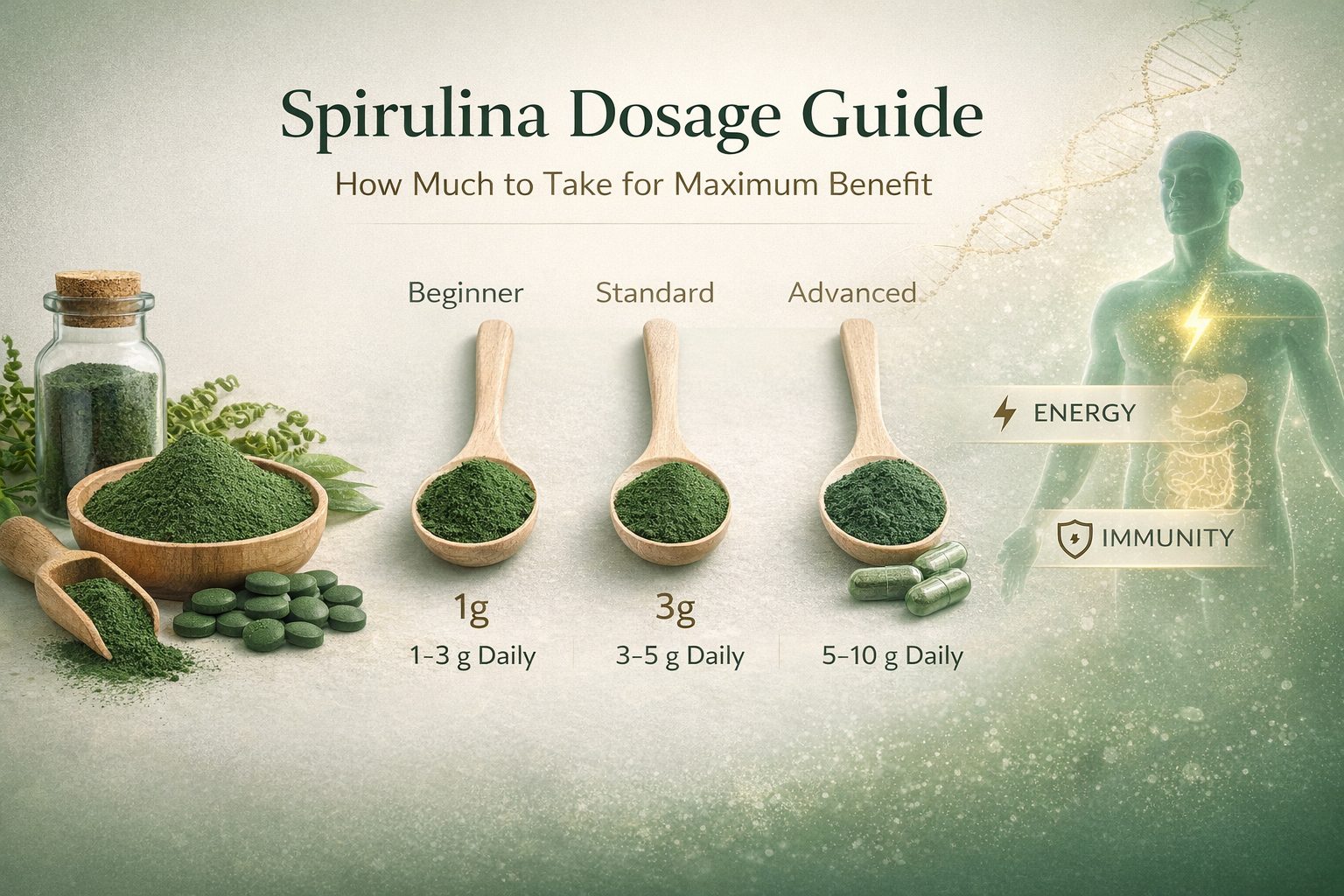
General Spirulina Dosage Recommendations
Most clinical studies on spirulina use doses ranging from 1 to 10 grams per day, with the majority falling between 2 and 8 grams. For someone new to spirulina who simply wants to support overall wellness, a daily dose of 3 to 5 grams is a well-supported starting point.
Research published in peer-reviewed journals has consistently shown that doses in this range can support antioxidant activity, healthy inflammatory responses, and cardiovascular markers without adverse effects. At the upper end of studied doses, 10 grams per day has been used safely in clinical settings, though most people find their optimal range well below that.
What matters as much as the dose is consistency. Spirulina’s benefits build over time. Many of the meaningful results in clinical studies — improved cholesterol levels, enhanced immune markers, better exercise endurance — appeared after 4 to 12 weeks of daily supplementation.
Spirulina Dosage for Weight Loss
Spirulina supports weight management through multiple mechanisms: its high protein content (60–70% by weight) promotes satiety, its phycocyanin may help regulate fat metabolism, and its nutrient density helps prevent the cravings that often accompany calorie restriction.
A 2020 meta-analysis found that spirulina supplementation led to significant reductions in body weight — roughly 2 to 3% of initial body weight over 8 to 12 weeks. The most consistent results appeared at doses of 2 to 3 grams daily, taken for a minimum of 7 to 8 weeks.
For best results, take spirulina 30 minutes before meals. The protein and fiber help reduce appetite so you naturally eat less at your next meal. Many people find that splitting the dose — 1 gram before lunch and 1 gram before dinner — provides steadier appetite control throughout the day.
Spirulina Dosage for Energy & Focus
Spirulina is one of the richest natural sources of B-vitamins, iron, and chlorophyll — all critical for cellular energy production. Its high bioavailable iron content is particularly relevant for the millions of people (especially women) who experience fatigue linked to low iron stores.
Most people report feeling a noticeable energy difference within the first 1 to 2 weeks at 3 grams per day. This isn’t the jittery stimulation of caffeine but rather a steady, sustained increase in baseline energy. For those who want more pronounced effects, studies have used up to 6 grams daily for fatigue reduction.
Take spirulina with breakfast or in a morning smoothie for the best energy support throughout the day. Avoid taking large doses in the evening, as some people find the energizing effect can interfere with sleep.
Spirulina Dosage for Immune Support
Spirulina contains several immunomodulatory compounds, with phycocyanin being the most studied. Research shows that spirulina can enhance natural killer (NK) cell activity, boost interferon production, and increase immunoglobulin A (IgA) levels — your body’s first line of mucosal defense.
For general immune maintenance, 2 grams daily is sufficient. Studies on allergic rhinitis (seasonal allergies) found that just 2 g/day significantly reduced nasal congestion, sneezing, and itching. For stronger immune modulation — during cold and flu season, for example — 4 to 5 grams daily provides more robust support.
Consistency matters more than dose for immunity. Taking 2 grams every day is more effective than taking 5 grams sporadically.
Spirulina Dosage for Athletes & Performance
Athletes have the highest spirulina requirements because intense training increases oxidative stress, inflammation, and nutrient demands. Research consistently shows that higher doses are needed to see measurable performance improvements.
For endurance athletes (runners, cyclists, swimmers), studies show that 6 to 7.5 grams daily improves fatigue tolerance, VO2 max, and hemoglobin levels. Strength athletes may benefit from 8 to 10 grams daily during heavy training blocks, as the high protein and antioxidant content supports muscle recovery and reduces delayed-onset muscle soreness (DOMS).
Timing for athletes: Split your dose across the day — take half with your pre-workout meal (1–2 hours before training) and half in your post-workout recovery shake. On rest days, you can take the full dose with breakfast.
Interactive Spirulina Dosage Calculator
Answer a few questions below to get a personalized daily spirulina recommendation based on your goals, body weight, activity level, and experience.
Spirulina Dosage Calculator
Get your personalized daily spirulina recommendation.
Your Ramp-Up Schedule
These are general guidelines based on clinical research. Always consult your healthcare provider before starting any supplement.
How to Start: The Ramp-Up Schedule
Starting with too much spirulina too quickly is the most common mistake. Even though spirulina is a whole food (not a synthetic supplement), its concentrated nutrient profile can cause mild digestive adjustment. Starting low and increasing gradually lets your body adapt comfortably.
| Week | Daily Dose | How to Take It |
|---|---|---|
| Week 1 | 1 gram (~¼ tsp) | Once daily, mixed into a smoothie or juice |
| Week 2 | 2 grams (~½ tsp) | Once daily with breakfast |
| Week 3 | 3 grams (~¾ tsp) | Split into morning and afternoon if preferred |
| Week 4+ | Your target dose | Consistent daily intake at your goal dose |
Before increasing your dose above 3g/day, review the known side effects of spirulina and who should avoid it entirely.
Best Time to Take Spirulina
When you take spirulina can influence how well it works for your specific goal. Here are the optimal timing strategies based on what you’re trying to achieve:
Powder vs. Tablets: Does Form Matter?
Both powder and tablets deliver the same nutritional profile, but there are practical differences worth considering when choosing your daily format:
| Factor | Powder | Tablets |
|---|---|---|
| Absorption speed | Faster — begins absorbing in the mouth | Slower — must dissolve in stomach first |
| Dosage flexibility | Highly flexible — measure any amount | Fixed 500mg increments |
| Convenience | Requires mixing into food or drink | Swallow with water — easy on the go |
| Taste | Full spirulina flavor (earthy, marine) | Minimal taste when swallowed quickly |
| High doses (6g+) | Easy — just 1.5 tsp | Requires swallowing 12+ tablets |
For most people, powder is the better choice — especially if you’re taking 3 grams or more per day. It’s more versatile, absorbs faster, and is far more practical at higher doses. Tablets are ideal for travel or for people who can’t stand the taste.
Why Freeze-Dried Spirulina Matters for Dosage
Not all spirulina is created equal, and the processing method directly affects how much active nutrition you actually get per gram. This is why dosage recommendations from studies using standard spray-dried spirulina may differ from what you need with freeze-dried spirulina.
Freeze-dried spirulina retains significantly more bioactive compounds than heat-processed alternatives. The enzymes, phycocyanin, chlorophyll, and B-vitamins that drive spirulina’s health benefits are all heat-sensitive. Spray-drying at high temperatures (150–200°C) degrades these compounds, which means you may need more grams to get the same effect.
With Royal Spirulina’s freeze-dried powder, the full enzymatic activity and phycocyanin content is preserved. This means you may experience the same benefits at the lower end of recommended dosage ranges compared to conventional spirulina products.
Ready to Start Your Spirulina Journey?
Our freeze-dried spirulina is USA-grown, enzymatically active, and lab-tested for purity. Start with our Starter Pack and find your perfect dose.
Shop Freeze-Dried SpirulinaFrequently Asked Questions
Related Reading
Best Time to Take Spirulina: Morning or Night? — Science-backed guidance on when to take spirulina for maximum absorption, energy, and sleep benefits.
Does Spirulina Break a Fast? What the Science Says — Find out whether spirulina breaks your fast — and why it might actually enhance your fasting results.
Spirulina for Liver Health: NAFLD, Fatty Liver & Detox — How spirulina protects against fatty liver disease through antioxidant, anti-inflammatory, and metabolic pathways.
Medical Disclaimer: The information in this guide is for educational purposes and is not a substitute for professional medical advice. Dosage recommendations are based on published clinical research and may not be appropriate for everyone. If you are pregnant, nursing, taking medication, or have a medical condition, consult your healthcare provider before starting spirulina supplementation. Individual results may vary.