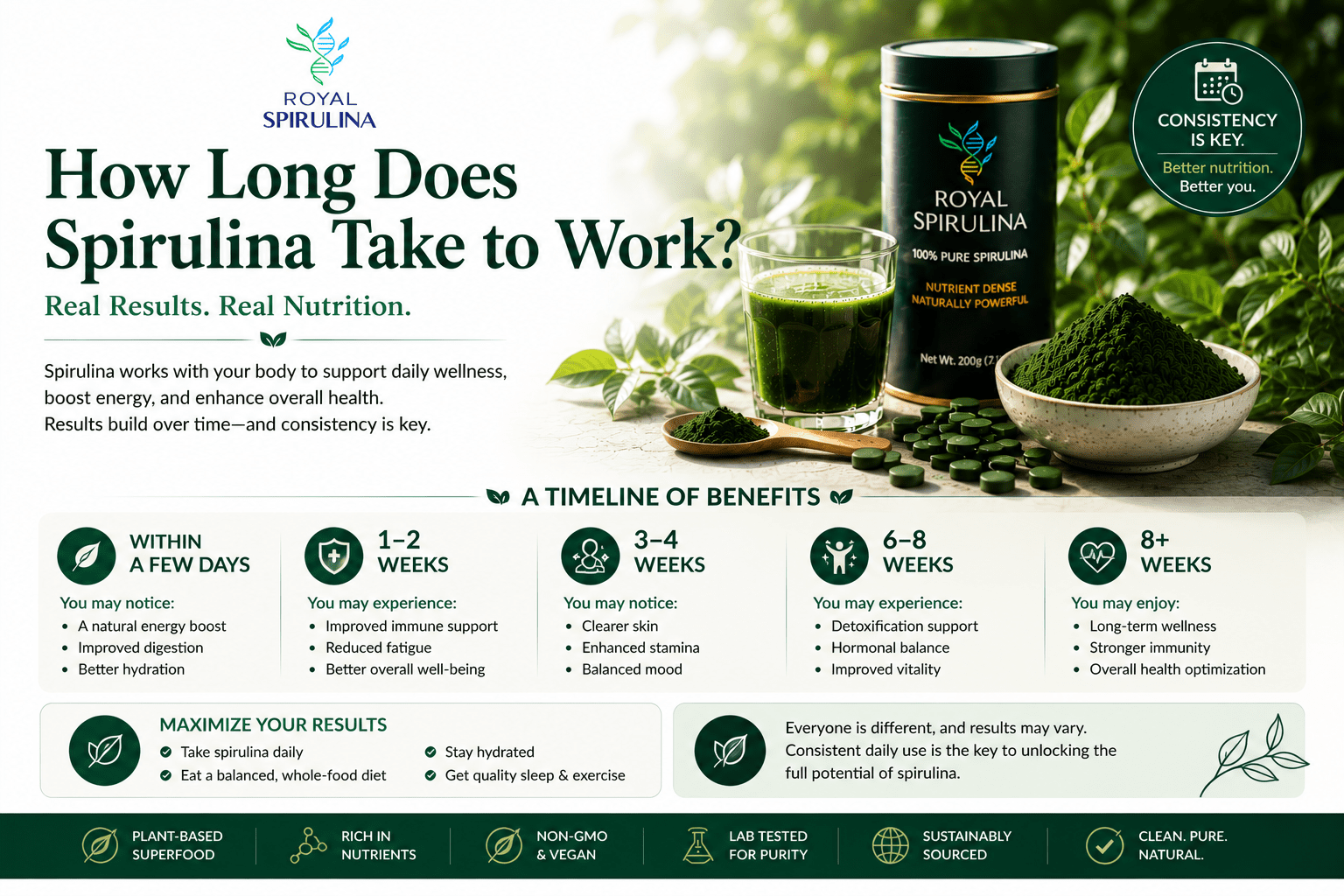
How Long Does Spirulina Take to Work? (What the Science Says)
It is one of the most common questions we hear from new spirulina users: “How long until I actually notice a difference?”
The honest answer is that it depends on what you are hoping to improve. Some benefits, like increased energy and exercise endurance, can appear within the first week or two. Others, such as meaningful cholesterol reduction or allergy relief, require consistent daily use for two to three months before the clinical data shows statistically significant changes.
The good news is that researchers have studied spirulina supplementation across dozens of randomised controlled trials (RCTs), giving us a solid evidence base for setting realistic expectations. In this article, we break down the science behind each category of benefit and provide clear timelines so you know exactly what to expect and when.
One important factor that many people overlook: the form and quality of spirulina you choose matters enormously. Freeze-dried spirulina, such as Royal Spirulina, preserves the full spectrum of bioactive compounds, antioxidants, and phycocyanin that drive these health benefits. Spray-dried imports, which dominate the market, use high heat that degrades many of these sensitive nutrients. This means that results from clinical studies, which typically use high-quality spirulina, may take longer to materialise if you are using an inferior product.
Timeline Summary: When to Expect Results
Before we dive into the detailed research, here is an overview of what the peer-reviewed literature tells us about typical timelines for each category of benefit:
| Health Benefit | Typical Timeline | Typical Dosage | Key Evidence |
|---|---|---|---|
| Energy & exercise performance | 1–4 weeks | 2–6 g/day | Meta-analysis of 22 RCTs (Wei et al., 2026) |
| Cholesterol & lipid improvement | 6–12 weeks | 1–4.5 g/day | Torres-Duran et al. (2007); Mazokopakis et al. (2013) |
| Blood pressure reduction | 6–12 weeks | 4.5 g/day | Martínez-Sámano et al. (2018); Shiri et al. (2025) |
| Anti-inflammatory effects (CRP, IL-6) | 4–12 weeks | 1–8 g/day | Hariri et al. (2026); Karimi et al. (2025) |
| Immune function support | 8 weeks | 2–6 g/day | Zhang et al. (2022) |
| Allergy relief (allergic rhinitis) | 8–12 weeks | 2 g/day | Mao et al. (2005) |
| Body composition (fat loss, weight) | 6–12 weeks | 4.5 g/day | Hernández-Lepe et al. (2018); Yasul et al. (2026) |
Now let us examine each benefit category in detail, with the specific study data that supports these timelines.
Energy and Exercise Performance (1–4 Weeks)
If there is one area where people tend to notice spirulina working quickly, it is energy and physical performance. Many users report feeling more alert and less fatigued within the first one to two weeks of supplementation. This is likely due to spirulina’s exceptionally high concentration of B-vitamins, iron, and the powerful antioxidant phycocyanin, which helps reduce exercise-induced oxidative stress.
The clinical evidence supports these early improvements. A comprehensive 2026 meta-analysis by Wei et al., which pooled data from 22 randomised controlled trials involving 822 participants, found that spirulina and microalgae supplementation significantly improved time to exhaustion (SMD 1.06) and VO2max (SMD 0.88), while also reducing creatine kinase (CK), a marker of muscle damage [9].
The mechanism is multifaceted. Spirulina’s antioxidant properties help neutralise reactive oxygen species generated during exercise, allowing muscles to perform longer before fatigue sets in. Additionally, spirulina’s high iron content supports oxygen transport, while its B12 and folate contribute to cellular energy production.
In the crossover RCT by Hernández-Lepe et al. (2018), 52 overweight and obese men taking 4.5 g/day of spirulina for 6 weeks showed significant improvements in VO2max, time to fatigue, and lactate threshold [4]. While this study measured outcomes at 6 weeks, many of the exercise-related benefits likely begin accruing much earlier, as the antioxidant and nutrient-delivery mechanisms begin working from the first dose.
What to expect: Most users report noticeable improvements in energy levels, workout endurance, and recovery speed within 1 to 4 weeks of consistent use at dosages of 2 g/day or higher.
Cholesterol and Lipid Improvements (4–12 Weeks)
Spirulina’s ability to improve blood lipid profiles is one of its most well-documented benefits, supported by multiple clinical trials and large meta-analyses. However, these changes involve fundamental shifts in lipoprotein metabolism and take longer to manifest than the energy improvements discussed above.
Results at 6 Weeks
Torres-Duran et al. (2007) conducted a landmark study on 36 subjects taking 4.5 g/day of spirulina for 6 weeks. The results were striking: triglycerides dropped from 233 to 167 mg/dL, total cholesterol decreased significantly, and HDL-C (the protective “good” cholesterol) increased. The researchers also observed reductions in both systolic and diastolic blood pressure [1].
Results at 12 Weeks
Mazokopakis et al. (2013) studied 52 patients with dyslipidaemia who took just 1 g/day of spirulina for 12 weeks. Even at this relatively low dose, the results were clinically meaningful: triglycerides decreased by 16.3%, LDL-C by 10.1%, and total cholesterol by 8.9% [2].
Meta-Analysis Confirmation
The large 2025 meta-analysis by Shiri et al., which synthesised data from 35 randomised controlled trials with intervention periods ranging from 3 to 16 weeks, confirmed spirulina’s lipid-lowering effects across the board: triglycerides decreased by an average of 14.75 mg/dL, total cholesterol by 11.5 mg/dL, and LDL-C by 7.69 mg/dL [7].
What to expect: At higher dosages (4–4.5 g/day), measurable lipid improvements can appear as early as 4–6 weeks. At lower dosages (1–2 g/day), allow 8–12 weeks for statistically significant changes. The combination of higher dosage plus high-quality freeze-dried spirulina like Royal Spirulina is likely to produce results toward the faster end of this range.
Blood Pressure Benefits (6–12 Weeks)
High blood pressure is a leading risk factor for cardiovascular disease, and spirulina has demonstrated a meaningful ability to lower both systolic and diastolic blood pressure when taken consistently.
Martínez-Sámano et al. (2018) studied hypertensive patients who took 4.5 g/day of spirulina for 12 weeks. The results showed decreased systolic blood pressure alongside significant reductions in endothelial damage markers, including sVCAM-1, sE-selectin, and endothelin-1. The researchers also observed improved antioxidant status, suggesting that spirulina protects blood vessel walls from oxidative damage while simultaneously lowering pressure [3].
The Shiri et al. (2025) meta-analysis of 35 RCTs confirmed average reductions of 3.85 mmHg in systolic blood pressure and 3.09 mmHg in diastolic blood pressure [7]. While these numbers may seem modest in isolation, a sustained reduction of even 3–5 mmHg in systolic blood pressure is associated with meaningful reductions in cardiovascular event risk at the population level.
The mechanism behind spirulina’s blood pressure effects involves multiple pathways: its high content of phycocyanin and other antioxidants reduce oxidative stress in blood vessel walls, while certain peptides in spirulina may inhibit angiotensin-converting enzyme (ACE) in a manner similar to pharmaceutical ACE inhibitors. Additionally, spirulina’s nitric oxide-promoting effects help relax blood vessels.
What to expect: Blood pressure improvements typically become measurable between 6 and 12 weeks of consistent supplementation at 4.5 g/day. Some individuals, particularly those with mildly elevated blood pressure, may notice improvements slightly earlier. Those with more severe hypertension should work with their doctor and not rely on spirulina alone.
Anti-Inflammatory Effects (4–12 Weeks)
Chronic low-grade inflammation underlies many modern diseases, from cardiovascular disease to autoimmune conditions to metabolic syndrome. Spirulina has demonstrated powerful anti-inflammatory effects in clinical trials, primarily through reductions in C-reactive protein (CRP), interleukin-6 (IL-6), and interleukin-1β (IL-1β).
CRP Reduction
The 2026 meta-analysis by Hariri et al., which pooled data from 8 RCTs using dosages ranging from 1 to 8 g/day over intervention periods of 3 to 16 weeks, found a significant reduction in CRP levels (weighted mean difference: −0.09 mg/L) [8]. CRP is one of the most important clinical markers of systemic inflammation and cardiovascular risk.
The Shiri et al. (2025) meta-analysis also found significant reductions in high-sensitivity CRP (hs-CRP) of 0.86 mg/L across the pooled studies [7].
IL-6 and IL-1β Reduction
Karimi et al. (2025) studied patients with relapsing-remitting multiple sclerosis (RRMS) who took just 1 g/day of spirulina for 12 weeks. The supplementation significantly reduced both IL-1β and IL-6 while improving physical function, energy levels, and overall health perception. Participants also experienced an average weight reduction of 2.85 kg [10].
These anti-inflammatory effects are particularly relevant because neuroinflammation is a key driver of MS progression, and the fact that such a low dose produced significant results speaks to spirulina’s potent immunomodulatory properties.
What to expect: Anti-inflammatory effects begin building from the first weeks of supplementation, but measurable reductions in inflammatory biomarkers typically require 4 to 12 weeks of consistent use. Higher dosages tend to produce faster and more pronounced effects.
Allergy Relief (8–12 Weeks)
For allergy sufferers, spirulina offers a natural approach to modulating the overactive immune response that causes hay fever, allergic rhinitis, and similar conditions. However, this represents one of the slower-acting benefits because it involves gradually reprogramming the immune system’s T-helper cell balance.
The key study in this area is by Mao et al. (2005), who gave allergic rhinitis patients 2,000 mg/day of spirulina for 12 weeks. The results showed a significant 32% reduction in interleukin-4 (IL-4), the cytokine primarily responsible for driving the Th2 (allergic) immune response [6]. By shifting the Th1/Th2 balance away from the allergic phenotype, spirulina reduced nasal discharge, sneezing, congestion, and itching.
The reason allergy relief takes longer than some other benefits is that spirulina is not merely suppressing symptoms like an antihistamine; it is fundamentally remodulating the immune system’s response pattern. This requires sustained daily exposure to spirulina’s bioactive compounds, particularly phycocyanin and polysaccharides, which interact with immune cells over time.
What to expect: Some users report mild improvements in allergy symptoms within 4 to 6 weeks, but the full immunomodulatory effect typically requires 8 to 12 weeks of daily supplementation at 2 g/day or higher. For best results during allergy season, begin supplementation at least 8 weeks before your typical symptom onset.
Body Composition Changes (6–12 Weeks)
Spirulina can support meaningful changes in body composition, including reduced body fat percentage, lower BMI, and decreased body weight. These changes are particularly pronounced when spirulina is combined with regular exercise.
Spirulina Alone
Hernández-Lepe et al. (2018) found that 4.5 g/day of spirulina for 6 weeks reduced body fat percentage in overweight and obese men, even without prescribed changes to their exercise routine [4]. The Shiri et al. (2025) meta-analysis confirmed an average weight reduction of 1.78 kg across pooled studies [7].
Spirulina Combined with Exercise
The 2026 meta-analysis by Yasul et al. examined the synergistic effects of spirulina combined with exercise over 6 to 12 weeks. The results were impressive: BMI decreased by 1.34 points, body fat by 3.03%, fasting blood glucose by 14.47 mg/dL, and LDL-C by 12.68 mg/dL, while VO2max improved by 3.25 mL/kg/min [11].
These synergistic effects make sense physiologically. Spirulina provides the antioxidant support and nutrient density that allows for better exercise recovery and performance, which in turn amplifies the metabolic and body composition benefits of physical activity.
What to expect: Measurable body composition changes typically appear between 6 and 12 weeks. The combination of spirulina supplementation with regular exercise accelerates results significantly compared to either intervention alone.
Immune Function Support (8 Weeks)
Spirulina’s ability to support and protect immune function has been demonstrated in high-stress scenarios where the immune system is under significant pressure.
Zhang et al. (2022) studied elite athletes undergoing intense training, which is known to suppress immune function and increase vulnerability to infection. After 8 weeks of spirulina supplementation, athletes maintained healthy leukocyte and monocyte levels that would otherwise decline under such training loads [5].
This immune-protective effect is relevant not only to athletes but to anyone under physical or psychological stress, recovering from illness, or seeking to maintain robust immune defences throughout the year.
What to expect: Immune function benefits accumulate over approximately 8 weeks of consistent supplementation, though some protective effects likely begin earlier. Consistent daily use is key.
Factors That Affect How Quickly Spirulina Works
Not everyone will experience results on exactly the same timeline. Several key factors influence how quickly you notice spirulina’s benefits:
1. Quality and Processing Method
This is perhaps the single most important factor that most people overlook. The processing method used to dry spirulina after harvest has a dramatic impact on the preservation of its bioactive compounds.
Freeze-dried spirulina (such as Royal Spirulina) is processed at low temperatures that preserve the delicate molecular structure of phycocyanin, chlorophyll, carotenoids, enzymes, and vitamins. This means you are getting the full potency of what clinical researchers use in their studies.
Spray-dried spirulina (the vast majority of Chinese imports) uses high heat that degrades heat-sensitive compounds. Studies have shown that spray-drying can destroy a significant portion of phycocyanin, the very compound responsible for many of spirulina’s anti-inflammatory, antioxidant, and immunomodulatory effects. If your spirulina has been heat-damaged, you may need higher dosages or longer timeframes to achieve the same results seen in clinical trials.
2. Dosage
As the research clearly shows, higher dosages tend to produce faster and more pronounced results. The studies demonstrating results at 6 weeks typically used 4.5 g/day, while those showing results at 12 weeks often used just 1–2 g/day. There appears to be a dose-response relationship where higher intakes (within the studied range of 1–8 g/day) accelerate the timeline to noticeable benefits.
3. Consistency
Spirulina is not a one-time intervention. Every clinical trial demonstrating significant results required daily, uninterrupted supplementation for the duration of the study period. Skipping days or taking spirulina sporadically will significantly delay or prevent results.
4. Baseline Health Status
People with more room for improvement tend to notice changes faster. For example, someone with elevated cholesterol is more likely to see a measurable drop than someone whose levels are already optimal. Similarly, individuals with higher levels of inflammation or oxidative stress may notice anti-inflammatory benefits sooner.
5. Diet and Lifestyle
Spirulina works best as part of an overall healthy lifestyle. Its benefits are amplified by a diet rich in whole foods, regular physical activity, adequate sleep, and stress management. Conversely, a highly processed diet, sedentary behaviour, and chronic stress may blunt some of spirulina’s effects.
6. Individual Variation
Genetics, gut microbiome composition, absorption efficiency, and other individual factors all play a role in how quickly any given person responds to supplementation. This is true for all supplements, not just spirulina.
Optimal Dosage for Fastest Results
Based on the clinical trial data reviewed above, here are dosage recommendations organised by your primary health goal:
| Health Goal | Recommended Dosage | Minimum Duration | Notes |
|---|---|---|---|
| General energy & wellbeing | 2–3 g/day | 2–4 weeks | Start here and increase if desired |
| Exercise performance & recovery | 4–6 g/day | 4–6 weeks | Take 1–2 hours before exercise |
| Cholesterol & lipid management | 4.5 g/day | 6–12 weeks | Higher dose = faster results |
| Blood pressure support | 4.5 g/day | 6–12 weeks | Do not replace prescribed medication |
| Anti-inflammatory effects | 2–8 g/day | 4–12 weeks | Even 1 g/day showed benefits in 12-week studies |
| Allergy relief | 2 g/day | 8–12 weeks | Begin well before allergy season |
| Weight & body composition | 4.5 g/day | 6–12 weeks | Best combined with regular exercise |
| Immune function | 2–6 g/day | 8 weeks | Especially important during high-stress periods |
A note on quality: These dosage recommendations assume you are using high-quality, freeze-dried spirulina like Royal Spirulina. If you are using spray-dried spirulina (most products sourced from China), you may need higher dosages to compensate for nutrient degradation during processing, and results may take longer to appear.
Frequently Asked Questions
Can I feel spirulina working on the first day?
Some people report a subtle energy boost on the very first day, likely due to spirulina’s rich B-vitamin and iron content providing immediate nutritional support. However, the major health benefits documented in clinical trials require weeks of consistent supplementation to develop. Think of the first-day effects as a hint of what is to come rather than the full picture.
Why do some people notice results faster than others?
Individual response times depend on several factors: your baseline nutritional status (those with deficiencies may respond faster), gut health and absorption efficiency, the severity of the condition you are trying to improve, the quality of spirulina you are taking, dosage, and genetic factors. People in poorer baseline health often notice improvements sooner simply because they have more room for improvement.
Does the form of spirulina (powder, tablets, capsules) affect how fast it works?
The processing method matters far more than the delivery form. A freeze-dried powder, tablet, or capsule will all deliver similar results if the underlying spirulina is the same quality. However, powder may be absorbed slightly faster since it does not need to disintegrate first. The critical distinction is between freeze-dried spirulina (which preserves bioactive compounds) and spray-dried spirulina (which degrades them through heat exposure).
Should I take a loading dose to get results faster?
While there is no specific clinical trial testing a “loading phase” protocol, starting at a moderate dose (2–3 g/day) for the first 3–5 days before increasing to your target dose (4–6 g/day) is a sensible approach. This allows your digestive system to adjust and minimises any initial detoxification effects. Jumping straight to a very high dose is unlikely to produce meaningfully faster results and may cause temporary digestive discomfort.
Will spirulina still work if I only take it a few days per week?
Every clinical trial demonstrating significant benefits used daily, uninterrupted supplementation. While occasional use still provides some nutritional value, the cumulative anti-inflammatory, lipid-modifying, and immunomodulatory effects require consistent daily exposure. If you are taking spirulina only sporadically, do not expect the results described in the research literature, and any benefits will take substantially longer to appear.
How do I know if spirulina is actually working for me?
For energy and exercise performance, you may notice subjective improvements. For cholesterol, blood pressure, and inflammatory markers, the only reliable way to confirm changes is through blood tests. Consider getting baseline blood work before starting supplementation and then retesting after 8 to 12 weeks. For allergy relief, track your symptom severity and antihistamine use over time.
Is freeze-dried spirulina really more effective than spray-dried?
Yes. Freeze-drying (lyophilisation) preserves spirulina’s bioactive compounds at low temperatures, maintaining the structural integrity of heat-sensitive molecules like phycocyanin, superoxide dismutase (SOD), and various vitamins. Spray-drying subjects spirulina to temperatures that can exceed 150 degrees Celsius, significantly degrading these compounds. Royal Spirulina uses freeze-drying specifically to ensure maximum potency and bioavailability, which is why it delivers results more aligned with what clinical studies report.
Can I take spirulina indefinitely, or should I cycle it?
Spirulina has been consumed as a food for centuries, and long-term studies have not identified any need for cycling. In fact, the longer you take spirulina, the more its benefits compound. Many of the cardiovascular and anti-inflammatory benefits continue to improve beyond the initial study periods. There is no evidence suggesting tolerance develops or that breaks are necessary.
The Bottom Line
Spirulina is not an overnight miracle, but it is also not something you need to take for months before noticing any difference. The scientific evidence paints a clear picture:
- Weeks 1–2: Many users notice improved energy, better exercise endurance, and faster recovery.
- Weeks 4–6: Measurable improvements in cholesterol, early anti-inflammatory effects, and initial body composition changes begin appearing in blood work.
- Weeks 8–12: The full spectrum of benefits becomes statistically significant, including blood pressure reduction, allergy relief, robust lipid improvements, and meaningful body composition changes.
The key to getting the fastest possible results is threefold: use a high-quality freeze-dried spirulina like Royal Spirulina (not heat-damaged spray-dried imports), take an adequate dosage (4–4.5 g/day for most therapeutic goals), and be completely consistent with daily use. With this approach, you are giving yourself the best chance of replicating the impressive results seen in clinical trials.
Scientific References
- Torres-Duran PV, Ferreira-Hermosillo A, Juárez-Oropeza MA. Antihyperlipemic and antihypertensive effects of Spirulina maxima in an open sample of Mexican population: a preliminary report. Lipids Health Dis. 2007;6:33. doi:10.1186/1476-511X-6-33. PMID: 18039384
- Mazokopakis EE, Starakis IK, Papadomanolaki MG, Mavroeidi NG, Ganotakis ES. The hypolipidaemic effects of Spirulina (Arthrospira platensis) supplementation in a Cretan population: a prospective study. J Sci Food Agric. 2014;94(3):432-437. doi:10.1002/jsfa.6261. PMID: 23754631
- Martínez-Sámano J, Torres-Montes de Oca A, Luqueno-Bocardo OI, Torres-Durán PV, Juárez-Oropeza MA. Spirulina maxima decreases endothelial damage and oxidative stress indicators in patients with systemic arterial hypertension: Results from exploratory controlled clinical trial. Mar Drugs. 2018;16(12):496. doi:10.3390/md16120496. PMID: 30544795
- Hernández-Lepe MA, Wall-Medrano A, Juárez-Oropeza MA, Ramos-Jiménez A, Hernández-Torres RP. Spirulina and its hypolipidemic and antioxidant effects in humans: a systematic review. Mar Drugs. 2018;16(10):364. doi:10.3390/md16100364. PMID: 30275428
- Zhang X, Hu T, Wang Y, et al. Spirulina supplementation prevents exercise-induced immunosuppression in elite athletes: a randomized, double-blind, placebo-controlled trial. Nutrients. 2022;14(20):4346. doi:10.3390/nu14204346. PMID: 36297029
- Mao TK, Van de Water J, Gershwin ME. Effects of a Spirulina-based dietary supplement on cytokine production from allergic rhinitis patients. J Med Food. 2005;8(1):27-30. doi:10.1089/jmf.2005.8.27. PMID: 15857205
- Shiri H, et al. Effects of spirulina supplementation on cardiometabolic risk factors: A systematic review and meta-analysis of randomized controlled trials. Complement Ther Med. 2025;103242. doi:10.1016/j.ctim.2025.103242. PMID: 40953712
- Hariri M, et al. The effect of spirulina supplementation on C-reactive protein: A systematic review and meta-analysis of randomized controlled trials. Int J Vitam Nutr Res. 2026. doi:10.31083/IJVNR44330. PMID: 41873104
- Wei L, et al. Effects of spirulina and microalgae supplementation on exercise performance: A systematic review and meta-analysis of 22 randomized controlled trials. Nutrients. 2026;18(8):1289. doi:10.3390/nu18081289. PMID: 42075102
- Karimi S, et al. Effect of Spirulina platensis supplementation on inflammation, quality of life, and body composition in patients with relapsing-remitting multiple sclerosis: a randomized controlled trial. Nutr J. 2025;24:74. doi:10.1186/s12937-025-01200-x. PMID: 40877830
- Yasul Y, et al. Combined effects of spirulina supplementation and exercise training on metabolic markers and body composition: A systematic review and meta-analysis. J Clin Med. 2026;15(6):2137. doi:10.3390/jcm15062137. PMID: 41899062
Related Reading
- The Complete Guide to Spirulina Benefits
- Spirulina Dosage Guide: How Much Should You Take?
- Best Time to Take Spirulina (Morning vs Night)
- What Happens When You Take Spirulina Every Day
- Spirulina for Heart Health: Cholesterol & Blood Pressure
- Spirulina for Athletes: Workout Performance & Recovery
- Spirulina for Allergies & Hay Fever
- Spirulina Powder vs Tablets vs Capsules: Which Is Best?
- Freeze-Dried vs Spray-Dried Spirulina: The Complete Guide
- What Does Spirulina Taste Like?
- Spirulina Side Effects: What to Know Before You Start