Overview
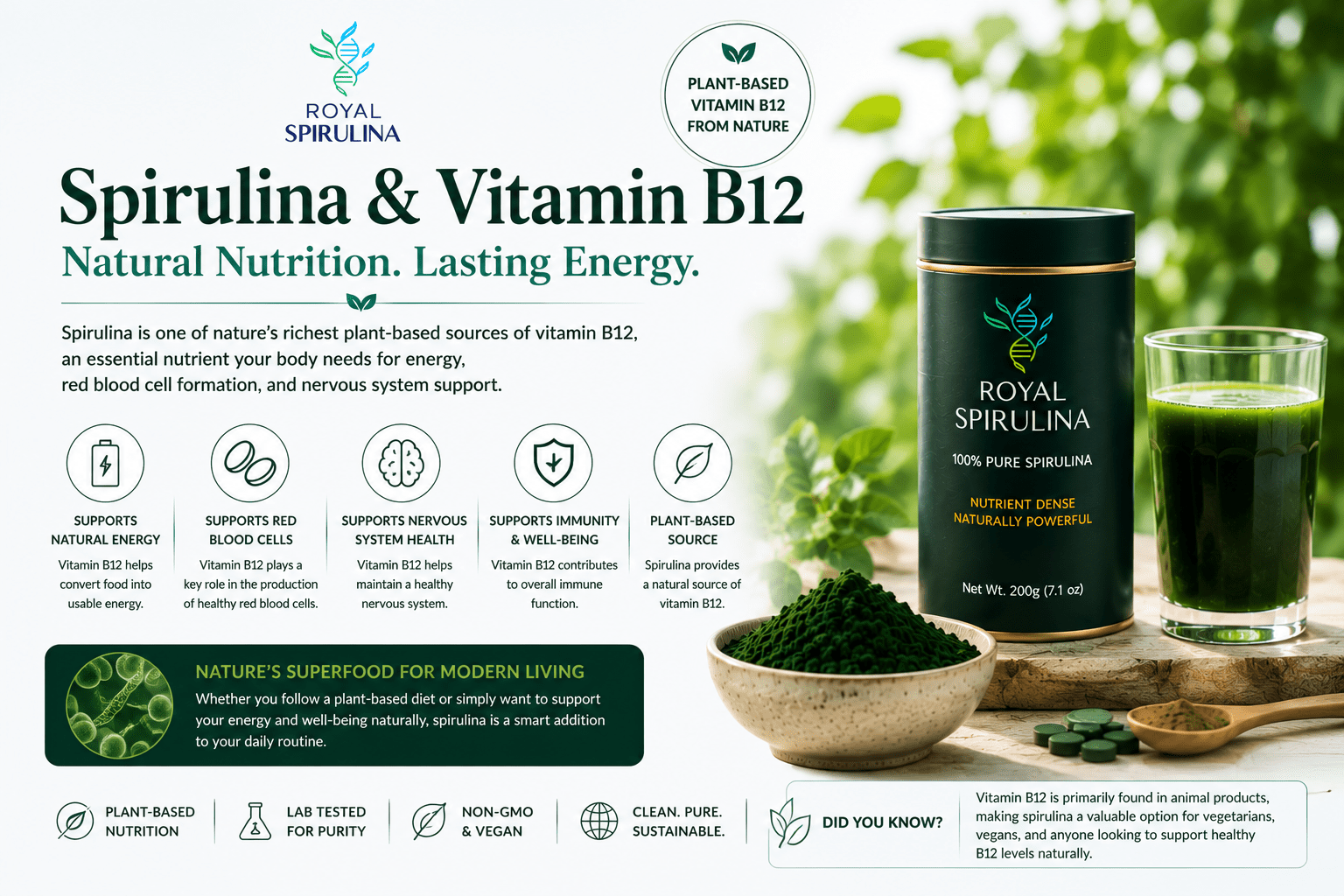
“Does spirulina have vitamin B12?” It’s one of the most common — and most misunderstood — questions in the superfood space. The short answer is yes, spirulina does contain vitamin B12. But the full answer is more nuanced than most blogs will tell you, and getting it right matters — especially if you’re vegan, vegetarian, or relying on plant-based sources for this critical nutrient.
The confusion stems from a compound called pseudovitamin B12 — a B12 analogue that spirulina produces alongside true vitamin B12. Some experts have warned that pseudovitamin B12 might actually block real B12 absorption, making spirulina not just useless but potentially harmful for B12 status. It’s a claim that has spread widely across health blogs, YouTube channels, and even some clinical nutrition resources.
But when you look at the peer-reviewed science — particularly the binding affinity data and a landmark 2019 animal study — the picture looks very different from what the internet has been telling you.
In this article, we break down exactly what the research says about spirulina and vitamin B12: what types of B12 spirulina actually contains, whether pseudovitamin B12 really blocks absorption, the animal study that showed spirulina improved B12 status in deficient subjects, and what all of this means for your health.
What Is Vitamin B12 and Why Does It Matter?
Vitamin B12 (cobalamin) is a water-soluble vitamin that plays essential roles in DNA synthesis, red blood cell formation, neurological function, and energy metabolism. It’s one of eight B vitamins, and it’s unique in several ways: it contains cobalt (which is why its chemical name includes “cobalamin”), it’s the largest and most structurally complex vitamin, and it can only be naturally synthesized by certain bacteria and archaea — not by plants or animals.
Humans cannot produce B12 internally and must obtain it from their diet. The recommended daily intake for adults is 2.4 micrograms (μg), though absorption rates vary significantly depending on the source, your digestive health, and your age.
B12 deficiency is more common than most people realize. According to research, it affects an estimated 6% of people under 60 and nearly 20% of those over 60 in the United States alone. Among vegans and vegetarians who don’t supplement, deficiency rates can reach 50–80%. Symptoms include fatigue, weakness, numbness or tingling in the hands and feet, difficulty walking, mood changes, memory problems, and in severe cases, irreversible neurological damage.
How Your Body Absorbs Vitamin B12
Understanding the B12 question in spirulina requires understanding how your body actually absorbs this vitamin — because the absorption mechanism is central to the pseudovitamin B12 debate.
When you eat food containing B12, the vitamin is released from proteins in your stomach by hydrochloric acid and pepsin. It then binds to a protein called intrinsic factor (IF), which is secreted by parietal cells in the stomach lining. This B12–intrinsic factor complex travels to the distal ileum (the end of the small intestine), where specialized receptors recognize the complex and absorb the B12 into your bloodstream.
Here’s what’s critical: intrinsic factor is selective. It has evolved to preferentially bind active vitamin B12 over inactive analogues. This selectivity is the key reason why concerns about pseudovitamin B12 “blocking” real B12 absorption don’t hold up under scientific scrutiny — as we’ll explain below.
Only about 50% of ingested vitamin B12 is absorbed under normal physiological conditions, and the IF-mediated system saturates at approximately 1.5–2.0 μg per meal. Any B12 beyond that amount must be absorbed through passive diffusion, which accounts for roughly 1% of the remaining dose.
Does Spirulina Actually Contain Vitamin B12?
Yes — spirulina contains both true vitamin B12 (cobalamin) and a related compound called pseudovitamin B12 (adeninyl cobamide). The cyanobacterium Limnospira fusiformis (formerly Spirulina platensis) is one of the few organisms capable of naturally synthesizing vitamin B12.
However, the ratio matters. In a landmark 1999 study published in the Journal of Agricultural and Food Chemistry, researcher Fumio Watanabe and colleagues analyzed spirulina tablets and found that approximately 83% of the corrinoid content was pseudovitamin B12, while only about 17% was true, biologically active vitamin B12.
This finding — that the majority of B12-like compounds in spirulina are pseudovitamin B12 rather than true cobalamin — is the basis for most warnings against using spirulina as a B12 source. But it’s only part of the story.
| Compound | % in Spirulina | Active in Humans? | Binds Intrinsic Factor? |
|---|---|---|---|
| True Vitamin B12 (cobalamin) | ~17% | Yes | Yes (strong binding) |
| Pseudovitamin B12 (adeninyl cobamide) | ~83% | Not directly | Very poorly (500× weaker) |
A more recent 2024 study by Durdakova et al., published in Food Chemistry, used advanced liquid chromatography with tandem mass spectrometry (LC-MS/MS) to measure cyanocobalamin (true B12) in Arthrospira maxima — a species closely related to commercial spirulina. They found 0.42–0.55 μg of cyanocobalamin per gram of dried weight, confirming that spirulina does indeed contain measurable amounts of true, active vitamin B12.
Pseudovitamin B12: What It Is and What It Isn’t
Pseudovitamin B12 (adeninyl cobamide) is structurally almost identical to true vitamin B12. Both share the same corrin ring — the central structure that defines all B12-related compounds. The critical difference lies in the lower axial ligand: where true vitamin B12 has a 5,6-dimethylbenzimidazole (DMB) moiety, pseudovitamin B12 has an adenine group instead.
This single structural difference has major implications for how the human body handles each compound:
| Property | True Vitamin B12 | Pseudovitamin B12 |
|---|---|---|
| Lower ligand | DMB (5,6-dimethylbenzimidazole) | Adenine |
| Intrinsic factor binding | Strong | ~500× weaker |
| Human bioactivity | Fully active | Not directly active |
| Active in spirulina cells | Yes | Yes (preferred cofactor) |
| Potential prebiotic role | Used by gut microbes | Used by gut microbes |
Importantly, pseudovitamin B12 is not a useless compound. A 2010 study by Tanioka et al. demonstrated that spirulina cells actually prefer pseudovitamin B12 as a cofactor for their methionine synthase enzyme — the very enzyme that B12 drives in human cells too. Pseudovitamin B12 serves a vital biological function; it’s just not the same function it would serve in the human body through the standard intrinsic factor absorption pathway.
Does Pseudovitamin B12 Block Real B12 Absorption? The Science Says No
This is the biggest misconception about spirulina and vitamin B12 — and it’s the one that matters most. Several health experts and popular YouTube channels have claimed that pseudovitamin B12 acts as a “competitive antagonist” to true B12, occupying the binding sites on intrinsic factor and blocking real B12 from being absorbed. If true, this would mean that taking spirulina could actually worsen your B12 status.
The peer-reviewed evidence does not support this claim.
The key study here is Stupperich and Nexø (1991), published in the European Journal of Biochemistry. This research directly measured the binding affinity of various corrinoids — including pseudovitamin B12 — for the three human B12-binding proteins: intrinsic factor, transcobalamin, and haptocorrin.
Their findings were decisive:
- Pseudovitamin B12 has approximately 500-fold (≥10³) lower binding affinity for intrinsic factor compared to true vitamin B12.
- Corrinoids without a coordinated nucleotide (like pseudovitamin B12, which has a weak cobalt-nitrogen coordination bond) were recognized ≥1,000 times less efficiently by intrinsic factor or transcobalamin than vitamin B12.
- Haptocorrin — a different B12-binding protein found in saliva and blood — bound all corrinoids with similar efficiency regardless of structure.
What does this mean in practical terms? For pseudovitamin B12 to meaningfully compete with real B12 for intrinsic factor binding sites, it would need to be present at concentrations hundreds of times higher than real B12 at the point of absorption. Even though pseudovitamin B12 outnumbers true B12 in spirulina by roughly 4:1, this ratio is nowhere near the 500:1+ that would be needed for significant competitive antagonism.
As the Royal Spirulina research report on this topic concluded: “The low affinity of pseudovitamin B12 for IF relative to vitamin B12 does not qualify pseudovitamin B12 as a viable competitive antagonist of vitamin B12.”
The Rat Study That Changed the Conversation
While the binding affinity data is compelling, the strongest evidence that spirulina can meaningfully contribute to B12 status comes from a 2019 animal study by Madhubalaji et al., published in the Journal of Food Biochemistry.
In this study, researchers fed vitamin B12-deficient Wistar rats a spirulina-supplemented diet for 10 weeks and measured multiple biomarkers of B12 status. The results were striking:
| Biomarker | B12-Deficient Group | Spirulina-Fed Group | Outcome |
|---|---|---|---|
| Urinary methylmalonic acid | 22.70 μmol/mol creatinine | 8.71 μmol/mol creatinine | Normalized to control levels |
| Plasma homocysteine | 16.55 μmol/L | 6.88 μmol/L | Normalized to control levels |
| Serum B12 | Severely depleted | 874.27 pg/mL | Similar to control |
| Testicular tissue | Severe atrophy | Normal architecture | Damage prevented |
| Lung and spleen tissue | Altered architecture | Normal architecture | Damage prevented |
Both methylmalonic acid (MMA) and homocysteine are considered gold-standard functional biomarkers of B12 status — they rise when B12 is deficient and normalize when B12 is adequate. The fact that spirulina supplementation brought both biomarkers back to control levels in B12-deficient rats is significant.
The researchers concluded: “The study validates that Spirulina can improve the vitamin B12 status” and described it as “a potential vegetarian source of bioavailable vitamin B12.”
This is an animal study, not a human clinical trial — and that distinction matters. But it provides the strongest direct evidence to date that the B12 compounds in spirulina are functionally bioavailable, and that the presence of pseudovitamin B12 does not prevent B12 from being absorbed and utilized.
Growing Conditions Affect B12 and Pseudovitamin B12 Content
Here’s something most spirulina articles don’t mention: the ratio of true B12 to pseudovitamin B12 in spirulina is not fixed. It depends heavily on growing conditions — particularly cobalt availability.
A 2001 study by Watanabe et al. found that when Spirulina platensis was grown in a cobalt-deficient medium, the amount of inactive corrinoid (pseudovitamin B12) decreased significantly. The addition of cobalt sulfate to the growing medium increased pseudovitamin B12 production, while growing without added cobalt kept pseudovitamin B12 levels low.
The researchers specifically noted: “The algal cells grown in the absence of CoSO4 are suitable for use of human health foods because the inactive corrinoid-compound can be reduced significantly.”
This finding suggests that spirulina producers who carefully control their growing conditions — particularly cobalt levels — can produce spirulina with a more favorable ratio of true B12 to pseudovitamin B12. It also means that not all spirulina products are equal when it comes to B12 content. The source, growing conditions, and quality controls matter enormously.
Pseudovitamin B12 and Your Gut Microbiome
Even if pseudovitamin B12 isn’t directly active in human cells, emerging research suggests it may still have value — through the gut microbiome.
Several species of bacteria common to the human gastrointestinal tract — including Limosilactobacillus reuteri, Anaerobutyricum hallii, and Bacteroides thetaiotaomicron — are known to synthesize and utilize pseudovitamin B12. These gut microbes uptake ingested corrinoids, including both true B12 and pseudovitamin B12, for their own metabolic processes.
A 2019 study by Kelly et al. published in Gut Microbes demonstrated that oral B12 supplementation reaches the distal gut and alters the corrinoid profile of the microbiome. This research showed that gut bacteria actively interact with different forms of B12, and that the corrinoid environment of the gut influences microbial composition.
The Royal Spirulina research report noted that this capability “could indicate the potential viability of pseudovitamin B12 as a prebiotic” — meaning pseudovitamin B12 may promote the growth and activity of beneficial gut bacteria. If confirmed by further research, this would reframe pseudovitamin B12 from a “contaminant” to a functional nutrient with its own health benefits.
The gut microbiome plays critical roles in human metabolism, nutrition, physiology, and immunoregulation. Should further research confirm pseudovitamin B12’s prebiotic potential, this corrinoid could find applications in restoring healthy gut composition in conditions like inflammatory bowel disease, obesity, diabetes, and allergic diseases.
Why Processing Method Matters for B12 Content
Vitamin B12 is sensitive to heat and light. This makes the processing method used to turn fresh spirulina into powder critically important for preserving whatever B12 content exists in the raw biomass.
Freeze-drying (lyophilization) operates at very low temperatures, typically below -40°C, preserving heat-sensitive nutrients including B12, phycocyanin, enzymes, and other bioactive compounds. Spray-drying — the method used by most large-scale Chinese spirulina producers — exposes the biomass to temperatures of 150–200°C, which can degrade heat-sensitive vitamins.
Watanabe’s 2013 review in the Journal of Agricultural and Food Chemistry specifically noted that “vitamin B12 is partially degraded and loses its biological activity during cooking and storage of foods.” This thermal degradation applies directly to spirulina processing: spray-drying at high temperatures can reduce the already-small fraction of true B12 in spirulina, while freeze-drying preserves it.
At Royal Spirulina, we use freeze-drying specifically because it preserves the full spectrum of bioactive compounds — including whatever true B12 is present — far more effectively than spray-dried imports. This is just one more reason why freeze-dried spirulina is superior to spray-dried Chinese imports.
Can Spirulina Replace a B12 Supplement?
Let’s be direct: based on current evidence, spirulina should not be used as your sole source of vitamin B12.
While the Madhubalaji rat study showed promising results, there are no published human clinical trials confirming that spirulina alone can maintain adequate B12 status in people. The 17% true B12 content, while real and measurable, may not provide enough active B12 per serving to meet your daily needs — especially if you follow a vegan or vegetarian diet with no other B12 sources.
Here’s what the research does support:
- Spirulina contains real, bioavailable vitamin B12 — not just pseudovitamin B12.
- Pseudovitamin B12 does not meaningfully block real B12 absorption — the binding affinity data makes this clear.
- Spirulina may contribute to overall B12 intake as part of a varied diet, but shouldn’t be relied upon as the only source.
- If you’re vegan or vegetarian, you should still take a dedicated B12 supplement (methylcobalamin or cyanocobalamin) or consume B12-fortified foods regularly.
Spirulina offers an extraordinary range of documented health benefits — from antioxidant protection and anti-inflammatory effects to cardiovascular support and immune modulation — but meeting your B12 needs shouldn’t be the primary reason you take it. Think of spirulina’s B12 content as a bonus, not a replacement for targeted supplementation.
Practical Recommendations
Based on the totality of the research — the Royal Spirulina pseudovitamin B12 report, Watanabe’s analyses, the Stupperich binding affinity data, and the Madhubalaji rat study — here’s how to approach spirulina and B12 intelligently:
| If You Are… | Recommendation |
|---|---|
| Vegan or strict vegetarian | Take spirulina for its many benefits + a separate B12 supplement (at least 250 μg/day cyanocobalamin or 1,000 μg twice weekly) |
| Vegetarian who eats eggs/dairy | Spirulina + dietary B12 from eggs and dairy may be sufficient; consider periodic blood testing |
| Omnivore taking spirulina | No B12 concern — you’re getting ample B12 from animal foods, and spirulina’s B12 content is a bonus |
| Over 50 (any diet) | B12 absorption decreases with age; consider supplementation regardless of diet + spirulina for overall health |
| Concerned about pseudovitamin B12 | Don’t be — the science shows it does NOT block real B12 absorption. Choose freeze-dried spirulina from a quality source |
What the Research Still Needs to Answer
While the current science is encouraging, several important questions remain unanswered:
- Human clinical trials are needed. The Madhubalaji rat study is promising, but we need controlled studies in humans measuring B12 status biomarkers (serum B12, MMA, homocysteine) in people consuming spirulina as a primary B12 source.
- Alternative absorption pathways. Intrinsic factor is the primary bottleneck for B12 absorption, but it’s currently unknown whether pseudovitamin B12 and other corrinoids can enter the bloodstream through other pathways beyond IF-mediated absorption.
- Conversion potential. Some researchers have raised the possibility that the human body — or gut microbes — might convert biologically inactive pseudovitamin B12 into its active form. This has not yet been confirmed.
- Optimal growing conditions. More research is needed to determine exactly which cultivation parameters produce spirulina with the highest ratio of true B12 to pseudovitamin B12.
- Prebiotic effects. The potential of pseudovitamin B12 to support beneficial gut bacteria deserves dedicated clinical investigation.
Frequently Asked Questions
Does spirulina contain real vitamin B12?
Yes. Spirulina contains both true vitamin B12 (cobalamin) and pseudovitamin B12 (adeninyl cobamide). Research using advanced LC-MS/MS analysis has confirmed the presence of cyanocobalamin at approximately 0.42–0.55 μg per gram of dried spirulina biomass. However, pseudovitamin B12 is present in larger quantities (roughly 83% of total corrinoids), which is why spirulina should not be relied upon as a sole B12 source.
Does pseudovitamin B12 in spirulina block real B12 absorption?
No. According to the Stupperich and Nexø (1991) study published in the European Journal of Biochemistry, pseudovitamin B12 has approximately 500-fold lower binding affinity for intrinsic factor — the protein your body uses to absorb B12 — compared to true vitamin B12. At the 4:1 ratio found in spirulina, pseudovitamin B12 cannot meaningfully compete with real B12 for absorption. The claim that it “blocks” B12 is not supported by the binding affinity data.
Can vegans use spirulina as their only B12 source?
Not recommended at this time. While a 2019 animal study showed that spirulina improved B12 status in deficient rats, no human clinical trials have confirmed this effect. Vegans should take a dedicated B12 supplement (methylcobalamin or cyanocobalamin) and consider spirulina’s B12 content as a complementary bonus, not a replacement.
Is spirulina safe to take if I’m concerned about B12?
Absolutely. The peer-reviewed evidence clearly shows that pseudovitamin B12 in spirulina does not interfere with real B12 absorption. You can safely take spirulina alongside a B12 supplement or B12-rich foods without any negative interaction. In fact, the Madhubalaji et al. (2019) rat study suggests spirulina may actually help improve B12 status.
Does freeze-dried spirulina have more B12 than spray-dried?
Freeze-drying preserves heat-sensitive nutrients more effectively than spray-drying. Since vitamin B12 is partially degraded by heat and light (as noted in Watanabe’s 2013 review), freeze-dried spirulina is likely to retain more of its original B12 content compared to spray-dried products exposed to temperatures of 150–200°C.
What is pseudovitamin B12 used for in spirulina cells?
Pseudovitamin B12 serves as the preferred cofactor for methionine synthase in spirulina cells — the same type of enzyme that true B12 drives in human cells. A 2010 study by Tanioka et al. showed that spirulina’s methionine synthase actually has higher affinity for pseudovitamin B12 than for true cobalamin. So pseudovitamin B12 is biologically active — just not in the human body through the standard absorption pathway.
Can growing conditions affect spirulina’s B12 content?
Yes. Research by Watanabe et al. (2001) demonstrated that growing spirulina in a cobalt-deficient medium significantly reduced pseudovitamin B12 content. This means spirulina producers can potentially optimize growing conditions to improve the ratio of true B12 to pseudovitamin B12 in their products.
Could pseudovitamin B12 have prebiotic benefits?
Emerging research suggests yes. Several species of beneficial gut bacteria — including Limosilactobacillus reuteri and Bacteroides thetaiotaomicron — are known to uptake and utilize pseudovitamin B12. This suggests pseudovitamin B12 may function as a prebiotic, supporting beneficial gut microbiome composition. However, this hypothesis requires dedicated clinical trials to confirm.
Scientific References
- Watanabe F, Katsura H, Takenaka S, et al. “Pseudovitamin B(12) is the predominant cobamide of an algal health food, spirulina tablets.” J Agric Food Chem. 1999;47(11):4736-41. PubMed | DOI
- Watanabe F, Miyamoto E, Nakano Y. “Inactive corrinoid-compound significantly decreases in Spirulina platensis grown in a cobalt-deficient medium.” J Agric Food Chem. 2001;49(11):5685-8. PubMed | DOI
- Watanabe F, Takenaka S, Kittaka-Katsura H, et al. “Characterization and bioavailability of vitamin B12-compounds from edible algae.” J Nutr Sci Vitaminol. 2002;48(5):325-31. PubMed | DOI
- Watanabe F. “Vitamin B12 sources and bioavailability.” Exp Biol Med. 2007;232(10):1266-74. PubMed | DOI
- Stupperich E, Nexø E. “Effect of the cobalt-N coordination on the cobamide recognition by the human vitamin B12 binding proteins intrinsic factor, transcobalamin and haptocorrin.” Eur J Biochem. 1991;199(2):299-303. PubMed | DOI
- Tanioka Y, Miyamoto E, Yabuta Y, et al. “Methyladeninylcobamide functions as the cofactor of methionine synthase in a Cyanobacterium, Spirulina platensis NIES-39.” FEBS Lett. 2010;584(14):3223-6. PubMed | DOI
- Watanabe F, Yabuta Y, Tanioka Y, Bito T. “Biologically active vitamin B12 compounds in foods for preventing deficiency among vegetarians and elderly subjects.” J Agric Food Chem. 2013;61(28):6769-75. PubMed | DOI
- Madhubalaji CK, Rashmi V, Chauhan VS, et al. “Improvement of vitamin B12 status with Spirulina supplementation in Wistar rats validated through functional and circulatory markers.” J Food Biochem. 2019;43(11):e13038. PubMed | DOI
- Kelly CJ, Alexeev EE, Farb L, et al. “Oral vitamin B12 supplement is delivered to the distal gut, altering the corrinoid profile and selectively depleting Bacteroides in C57BL/6 mice.” Gut Microbes. 2019;10(6):654-662. PubMed | DOI
- Durdakova M, Kolackova M, Ridoskova A, et al. “Exploring the potential nutritional benefits of Arthrospira maxima and Chlorella vulgaris: A focus on vitamin B12, amino acids, and micronutrients.” Food Chem. 2024;452:139434. PubMed | DOI
- Gupta V. “Vitamin B12 (Cobalamin).” StatPearls. U.S. National Library of Medicine, 2021. NCBI Bookshelf
- Royal Spirulina. “Pseudovitamin B12 as an Inhibitor of Vitamin B12 Absorption.” Research Paper / SOP Research, Revision 01, August 5, 2021.
Related Reading
Spirulina Benefits: What Does the Science Actually Say? — A comprehensive, research-backed guide to 15 documented health benefits of spirulina, from antioxidants and inflammation to heart health and athletic performance.
Spirulina Side Effects: What the Research Actually Shows — An honest look at spirulina side effects, who should avoid it, and why most complaints are actually quality problems in disguise.
Can You Take Spirulina and Chlorella Together? — Science says the combination may offer broader health benefits than either alone. Chlorella also contains B12 — true cobalamin, not pseudovitamin B12.
Spirulina vs Chlorella: Which Superfood Is Better? — A head-to-head comparison of these two green superfoods, including their B12 content and bioavailability differences.
Freeze-Dried vs Spray-Dried Spirulina: Complete Quality Comparison — Why freeze-dried spirulina preserves 40% more bioavailable nutrition than spray-dried imports, including heat-sensitive vitamins like B12.
Spirulina Benefits for Women — Women are at higher risk for B12 deficiency, especially during pregnancy. Learn how spirulina supports women’s health across multiple dimensions.
Spirulina During Pregnancy: Benefits, Safety, and What You Need to Know — B12 is critical during pregnancy. Learn about spirulina’s role in supporting maternal nutrition.
What to Avoid When Taking Spirulina — Drug interactions, timing tips, and substances that don’t mix well with spirulina supplementation.
Spirulina Dosage Guide: How Much Should You Take Per Day? — Science-backed dosage recommendations by health goal, including interactive calculator.
Spirulina vs Moringa: Which Superfood Is Better? — A science-based comparison of spirulina and moringa covering nutrition, benefits, and who should take which.