Overview
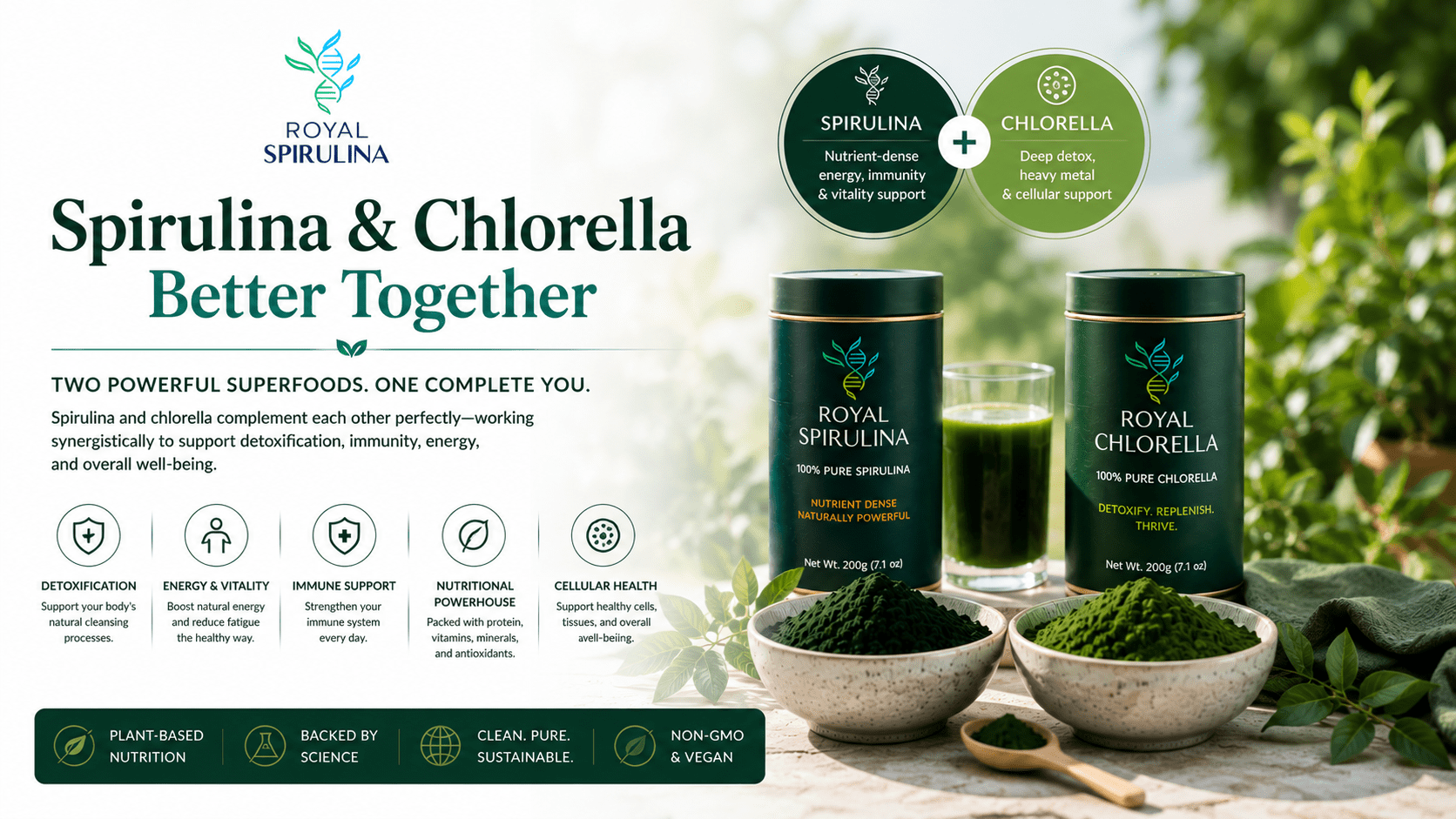
Spirulina and chlorella are two of the most popular green superfoods on the market — and for good reason. Both are nutrient-dense microalgae with decades of scientific research behind them. But they are quite different organisms with distinct nutritional profiles and health benefits. A question that comes up frequently is: can you take spirulina and chlorella together?
The short answer is yes — and there may be real advantages to combining them. While spirulina excels in anti-inflammatory and antioxidant activity (largely due to its unique pigment phycocyanin), chlorella brings powerful detoxification support and immune-boosting properties. Together, they cover more nutritional ground than either one alone.
This article breaks down the science behind each, compares their nutritional profiles, examines what the research says about combining them, and helps you decide whether a spirulina-chlorella stack makes sense for your health goals.
Spirulina vs. Chlorella: What’s the Difference?
Despite often being grouped together as “green superfoods,” spirulina and chlorella are fundamentally different organisms.
Spirulina (Arthrospira platensis) is a blue-green cyanobacterium — technically not a true alga, but a photosynthetic bacterium. It grows in alkaline freshwater lakes and has been consumed for centuries. Spirulina is distinguished by its vibrant blue-green color, which comes from phycocyanin, a pigment-protein complex with potent antioxidant and anti-inflammatory properties. It contains 60–70% protein by dry weight, is rich in B-vitamins, iron, and gamma-linolenic acid (GLA), and has no cellulose cell wall — making it highly digestible without any processing.
Chlorella (Chlorella vulgaris or Chlorella pyrenoidosa) is a true single-celled green alga. It is one of the oldest life forms on Earth and is distinguished by its deep green color from high chlorophyll content — roughly 3–5% by dry weight, significantly more than spirulina. Chlorella contains 50–60% protein, is rich in vitamins C and B12, and contains a unique compound called Chlorella Growth Factor (CGF), a nucleotide-peptide complex that supports cellular repair. Critically, chlorella has a tough cellulose cell wall that must be “cracked” during processing to make its nutrients bioavailable.
Nutritional Comparison: Spirulina vs. Chlorella
The table below compares typical nutrient profiles per 10 g serving (roughly 2 teaspoons of powder or about 20 tablets):
| Nutrient | Spirulina (10 g) | Chlorella (10 g) |
|---|---|---|
| Protein | 6–7 g | 5–6 g |
| Chlorophyll | ~100 mg | ~300 mg |
| Phycocyanin | ~1,500 mg | None |
| Iron | ~2.8 mg (20% DV) | ~1.3 mg (9% DV) |
| Vitamin B12 | True B12 + pseudovitamin B12 | Bioactive B12 |
| Vitamin C | Trace | ~1 mg |
| GLA (Omega-6) | ~100 mg | Minimal |
| Chlorella Growth Factor | None | Present |
| Cell Wall | None (highly digestible) | Tough (must be cracked) |
| Key Pigment | Phycocyanin (blue) | Chlorophyll (green) |
In short, spirulina leads in protein density, iron, phycocyanin, and GLA, while chlorella leads in chlorophyll, bioactive B12, vitamin C, and detoxification compounds. Together, they fill each other’s nutritional gaps.
Can You Safely Take Spirulina and Chlorella Together?
Yes. There are no known adverse interactions between spirulina and chlorella. Both have extensive safety profiles in human studies, and several research papers have deliberately combined them.
A 2021 study published in the Journal of Diabetes and Metabolic Disorders tested spirulina and chlorella both alone and in combination in diabetic rats. The researchers found that the combined supplementation group showed improvements in wound healing comparable to — and in some metabolic markers better than — either supplement alone, with no adverse effects reported from the combination (DOI).
A 2024 study in fish found that combined 5% spirulina + 5% chlorella supplementation reduced total cholesterol more effectively than either microalga given alone at 10%, suggesting synergistic metabolic benefits (DOI).
A 2026 meta-analysis of 22 randomized controlled trials examining algae supplementation and exercise performance included studies using both spirulina and chlorella, and found both were well-tolerated with no reported safety concerns when used in conjunction with exercise protocols (DOI).
Complementary Benefits: What Each Brings to the Stack
The real value of combining spirulina and chlorella lies in their complementary mechanisms of action. Rather than overlapping, their benefits tend to cover different biological pathways.
What Spirulina Contributes
Phycocyanin-driven antioxidant and anti-inflammatory power. A comprehensive 2016 review in Archives of Toxicology documented that spirulina activates cellular antioxidant enzymes (superoxide dismutase, catalase), inhibits lipid peroxidation, scavenges free radicals, and modulates inflammatory pathways including NF-κB. Clinical trials confirmed it prevents skeletal muscle damage under exercise-induced oxidative stress and modulates cytokine expression for immunomodulatory and anti-inflammatory responses (DOI).
Blood pressure reduction. A 2025 meta-analysis comparing chlorella and spirulina for cardiovascular risk factors found that spirulina intake led to a significant reduction in diastolic blood pressure, while chlorella had a neutral effect on blood pressure. Spirulina also showed a trend toward reducing total cholesterol (DOI).
Anti-inflammatory effects in clinical trials. A 2025 triple-blind RCT in multiple sclerosis patients found that 1 g/day spirulina for 12 weeks significantly reduced pro-inflammatory markers IL-1β and IL-6, and improved multiple quality-of-life domains compared to placebo (DOI).
What Chlorella Contributes
Immune system activation. A double-blinded, placebo-controlled RCT found that 8 weeks of chlorella supplementation (5 g/day) significantly increased Natural Killer (NK) cell activity and raised levels of interferon-γ, interleukin-1β, and interleukin-12 — key Th1 immune cytokines — in healthy adults (DOI).
Cholesterol reduction. A 2022 dose-response meta-analysis of 10 RCTs (539 adults) found that chlorella supplementation significantly reduced total cholesterol by 7.47 mg/dL and LDL cholesterol by 7.71 mg/dL. The LDL-lowering effect was most pronounced at dosages up to 1,500 mg/day (DOI).
Heavy metal detoxification. Chlorella is well-documented for its ability to bind and remove heavy metals. Its cell wall contains phytochelatins — specialized metal-binding proteins — that chelate cadmium, lead, copper, and zinc. Research has shown that chlorella can remove over 80% of cadmium, copper, and lead from contaminated environments (DOI).
Metabolic support. A 2021 systematic review of 12 RCTs found that chlorella supplementation may have beneficial effects on body weight, lipid profile, and blood glucose in the context of obesity-related metabolic disorders (DOI).
Combined Benefits at a Glance
| Health Benefit | Spirulina | Chlorella | Combined |
|---|---|---|---|
| Anti-inflammatory | ★★★★★ | ★★★ | ★★★★★ |
| Antioxidant protection | ★★★★★ | ★★★★ | ★★★★★ |
| Heavy metal detox | ★★ | ★★★★★ | ★★★★★ |
| Immune support | ★★★★ | ★★★★★ | ★★★★★ |
| Blood pressure support | ★★★★ | ★★ | ★★★★ |
| Cholesterol reduction | ★★★ | ★★★★ | ★★★★★ |
| Exercise performance | ★★★★ | ★★★★ | ★★★★★ |
| Protein content | ★★★★★ | ★★★★ | ★★★★★ |
| Chlorophyll / detox support | ★★★ | ★★★★★ | ★★★★★ |
Exercise and Athletic Performance
Both spirulina and chlorella have shown promise for athletes, but through slightly different mechanisms.
A 2026 systematic review and meta-analysis of 22 RCTs (822 participants) found that algae supplementation — including both spirulina and chlorella — significantly improved time to exhaustion (TTE), maximal power output, and VO₂max, while also significantly reducing creatine kinase (a marker of exercise-induced muscle damage). Subgroup analysis suggested greater effects for chlorella supplementation on muscle damage recovery, and for spirulina on aerobic performance (DOI).
This suggests that combining both could offer dual athletic benefits: spirulina to boost endurance and reduce oxidative stress during exercise, and chlorella to accelerate muscle recovery afterward.
Dosage and Timing for the Combined Stack
Based on the research literature, here are evidence-based dosage guidelines:
| Supplement | Daily Dose | Timing | Notes |
|---|---|---|---|
| Spirulina | 3–5 g | Morning or pre-workout | Best on empty stomach or with light meal |
| Chlorella | 3–5 g | With meals | Take with food to support detox binding |
| Combined total | 6–10 g | Split across day | Start low (2–3 g each) and increase over 1–2 weeks |
Tips for combining:
- Start slowly. If you’re new to either supplement, begin with 1–2 g of each daily and increase gradually over 7–14 days. Both can cause mild digestive symptoms (especially chlorella) during the first few days.
- Separate or combine — both work. You can take them together in a smoothie or take spirulina in the morning and chlorella with lunch. There is no evidence that taking them together reduces absorption.
- Stay hydrated. Both supplements support detoxification processes, so adequate water intake is important.
- Choose cracked-cell chlorella. Unprocessed chlorella has a tough cellulose wall that prevents nutrient absorption. Always choose “broken cell wall” or “cracked cell” chlorella products.
Quality Matters: Freeze-Dried vs. Spray-Dried
When combining spirulina and chlorella, quality is critical for both supplements.
For spirulina, the processing method has a major impact on nutrient retention. Freeze-dried spirulina — like Royal Spirulina — preserves the delicate phycocyanin pigment, antioxidants, enzymes, and heat-sensitive B-vitamins far more effectively than spray-dried alternatives. Spray-drying, commonly used by Chinese bulk producers, exposes spirulina to temperatures of 150–200°C that can degrade phycocyanin by 30–50% and destroy enzymes and heat-sensitive nutrients.
For chlorella, the most important quality factor is cell wall processing. Look for “broken cell wall” or “cracked cell” chlorella — without this processing step, your body cannot access the nutrients locked inside chlorella’s tough cellulose cell wall. Additionally, choose chlorella grown in clean, controlled environments, as its heavy-metal-binding ability means it will also absorb contaminants from polluted growing environments.
For both supplements: source matters. Look for products grown in controlled, clean-water environments with third-party testing for heavy metals, microcystins, and contaminants.
Who Benefits Most from Combining Spirulina and Chlorella?
| Population | Why the Combination Helps |
|---|---|
| Athletes & active individuals | Spirulina boosts endurance and reduces oxidative stress; chlorella accelerates muscle recovery and reduces creatine kinase |
| People with high toxin exposure | Chlorella binds heavy metals; spirulina provides antioxidant protection against toxin-induced damage |
| Those managing cholesterol | Chlorella lowers TC and LDL; spirulina supports overall cardiovascular health and blood pressure |
| Immune-compromised individuals | Chlorella boosts NK cells and Th1 cytokines; spirulina modulates overall inflammatory response |
| Vegans & vegetarians | Together they provide complete protein, bioactive B12 (from chlorella), iron (from spirulina), and essential fatty acids |
| General wellness seekers | Broadest spectrum of nutrients, antioxidants, and bioactive compounds from two complementary superfoods |
Potential Side Effects and Precautions
Both spirulina and chlorella are generally well-tolerated. The most common side effects when starting either supplement are mild and temporary:
- Digestive discomfort: Gas, bloating, or loose stools — especially with chlorella due to its high chlorophyll content and cell wall fiber. This typically resolves within 3–5 days.
- Green stool: Completely normal and harmless — it’s simply the chlorophyll.
- Mild headache or fatigue: Some users report this in the first few days, possibly related to detoxification processes.
Precautions:
- Autoimmune conditions: Both spirulina and chlorella stimulate the immune system. If you have an autoimmune disorder (lupus, rheumatoid arthritis, MS), consult your physician before taking either supplement.
- Blood thinners: Spirulina contains vitamin K. If you’re on warfarin or other anticoagulants, consult your doctor.
- Phenylketonuria (PKU): Spirulina contains phenylalanine and should be avoided by individuals with PKU.
- Pregnancy/breastfeeding: While generally considered safe, consult your healthcare provider before starting any new supplement during pregnancy or lactation.
Frequently Asked Questions
Can you take spirulina and chlorella at the same time?
Yes. There are no known negative interactions between spirulina and chlorella. They can be taken together in the same smoothie, mixed in water, or taken as tablets at the same time. Research has tested them in combination without reporting adverse effects.
Which is better, spirulina or chlorella?
Neither is universally “better” — they excel in different areas. Spirulina is stronger for anti-inflammatory effects, blood pressure, and phycocyanin antioxidants. Chlorella is stronger for immune activation (NK cells), heavy metal detoxification, and chlorophyll content. Together, they complement each other’s strengths.
Can chlorella detox heavy metals from the body?
Chlorella’s cell wall contains phytochelatins, specialized metal-binding proteins shown to chelate cadmium, lead, copper, and zinc. While most detoxification research has been conducted in laboratory and animal models, chlorella’s metal-binding capacity is well-documented. Human clinical trials specifically on heavy metal detox in humans are limited but ongoing.
How much spirulina and chlorella should I take daily?
Most studies use 3–5 g per day of each supplement. If combining both, a total of 6–10 g per day (split between the two) is common. Start with 1–2 g of each and gradually increase over 1–2 weeks to minimize digestive adjustment.
Is it better to take spirulina in the morning and chlorella at night?
There’s no strict rule. Some practitioners recommend spirulina in the morning for its energizing B-vitamins and iron, and chlorella with meals to support detoxification binding in the gut. However, taking both together is also perfectly fine — absorption is not reduced by combining them.
Does chlorella interfere with spirulina absorption?
No. There is no evidence that chlorella interferes with spirulina absorption or vice versa. The two have different nutrient profiles and mechanisms of action that work through independent pathways.
Is freeze-dried spirulina better when combining with chlorella?
Yes. Freeze-dried spirulina retains more of its phycocyanin, antioxidants, and enzymes compared to spray-dried varieties. Since the primary advantage spirulina brings to the combination is its anti-inflammatory and antioxidant power, preserving these compounds through freeze-drying is essential. Pairing high-quality freeze-dried spirulina with cracked-cell-wall chlorella gives you the best of both worlds.
Can I take spirulina and chlorella with other supplements?
Yes. Both are whole-food supplements and are compatible with most vitamins, minerals, probiotics, and other supplements. If you take medications (especially blood thinners, immunosuppressants, or thyroid medications), consult your healthcare provider.
The Bottom Line
| Key Takeaway | Details |
|---|---|
| Safe to combine? | Yes — no known adverse interactions; studied in combination |
| Synergistic benefits? | Yes — complementary antioxidant, immune, detox, and anti-inflammatory pathways |
| Best combined dose | 3–5 g spirulina + 3–5 g chlorella daily (6–10 g total) |
| Spirulina’s main advantage | Phycocyanin-driven anti-inflammatory and antioxidant power; blood pressure support |
| Chlorella’s main advantage | NK cell immune boost; heavy metal detox; LDL cholesterol reduction |
| Quality tip | Choose freeze-dried spirulina (not spray-dried) and cracked-cell-wall chlorella for maximum bioavailability |
Spirulina and chlorella are two of nature’s most nutrient-dense superfoods, and combining them is not only safe but may offer broader health benefits than taking either one alone. The science points to complementary mechanisms — spirulina’s phycocyanin targeting inflammation and oxidative stress, chlorella’s cell wall compounds binding toxins and boosting innate immunity — making them a natural pairing for anyone serious about whole-body wellness.
References
- Wu Q, Liu L, Miron A, et al. The antioxidant, immunomodulatory, and anti-inflammatory activities of Spirulina: an overview. Arch Toxicol. 2016;90(8):1817-40. DOI | PMID: 27259333
- Kwak JH, Baek SH, Woo Y, et al. Beneficial immunostimulatory effect of short-term Chlorella supplementation: enhancement of natural killer cell activity and early inflammatory response. Nutr J. 2012;11:53. DOI | PMID: 22849818
- Sherafati N, Bideshki MV, Behzadi M, et al. Effect of supplementation with Chlorella vulgaris on lipid profile in adults: A systematic review and dose-response meta-analysis. Complement Ther Med. 2022;66:102822. DOI | PMID: 35331862
- Mehdinezhad N, Aryaeian N, Vafa M, et al. Effect of spirulina and chlorella alone and combined on the healing process of diabetic wounds. J Diabetes Metab Disord. 2021;20(1):161-169. DOI | PMID: 34222063
- Ferreira ACDS, Pacheco AM, Salomão CB, et al. Hematological and anthelminthic responses of tambaqui supplemented with Arthrospira platensis and Chlorella vulgaris. Braz J Biol. 2024;84:e278486. DOI | PMID: 38985059
- Wei Y, Liu S, You T, et al. The Effects of Seaweed and Microalgae Supplementation on Exercise Performance and Recovery: A Systematic Review and Meta-Analysis. Nutrients. 2026;18(8). DOI | PMID: 42075102
- Pinto-Leite M, Martins D, Ferreira AC, et al. The Role of Chlorella and Spirulina as Adjuvants of Cardiovascular Risk Factor Control: A Systematic Review and Meta-Analysis. Nutrients. 2025;17(6). DOI | PMID: 40289965
- Karimi S, Shaygannejad V, Mohammadalipour A, et al. Effects of spirulina supplementation on inflammation, quality of life, and anthropometric measures in patients with RRMS. Nutr J. 2025;24(1):132. DOI | PMID: 40877830
- Sanayei M, Kalejahi P, Mahinkazemi M, et al. The effect of Chlorella vulgaris on obesity related metabolic disorders: a systematic review. J Complement Integr Med. 2021;19(4):833-842. DOI | PMID: 33951762
- Zhang W, Tan NGJ, Li SFY. NMR-based metabolomics and LC-MS/MS quantification reveal metal-specific tolerance and redox homeostasis in Chlorella vulgaris. Mol Biosyst. 2014;10(1):149-60. DOI | PMID: 24226509
- Cheng D, Wan Z, Zhang X, et al. Dietary Chlorella vulgaris Ameliorates Altered Immunomodulatory Functions in Cyclophosphamide-Induced Immunosuppressive Mice. Nutrients. 2017;9(7). DOI | PMID: 28684674
- Santos HO, Price JC, Bueno AA. Beyond Fish Oil Supplementation: The Effects of Alternative Plant Sources of Omega-3 Polyunsaturated Fatty Acids upon Cardiometabolic Biomarkers. Nutrients. 2020;12(10):3159. DOI | PMID: 33081119
- Lowry E, Marley J, McVeigh JG, et al. Dietary Interventions in the Management of Fibromyalgia: A Systematic Review and Best-Evidence Synthesis. Nutrients. 2020;12(9):2664. DOI | PMID: 32878326
- Ahammed MS, Baten MA, Ali MA, et al. Comparative Evaluation of Chlorella and Spirulina for Phycoremediation of Polluted River Water: Heavy Metals Detoxification. Biology. 2023;12(5):675. DOI | PMID: 37237489
Related Reading
Spirulina Health Benefits: A Complete Guide — A comprehensive overview of spirulina’s evidence-based health benefits, from immune support to athletic performance.
Blue Spirulina & Phycocyanin: The Science Behind the Blue Pigment — Deep dive into phycocyanin, the blue pigment unique to spirulina, and why it matters for your health.
Spirulina for Heart Health: Cholesterol & Blood Pressure — How spirulina lowers LDL cholesterol, triglycerides, and blood pressure based on multiple meta-analyses.
Spirulina Side Effects: What You Need to Know — Understand potential side effects, contraindications, and safety considerations for spirulina supplementation.
What to Avoid When Taking Spirulina — Key interactions and timing considerations for getting the most from your spirulina supplement.
Spirulina Benefits for Women — From iron replenishment to hormonal balance, discover why spirulina is especially valuable for women’s health.
Spirulina Benefits for Men — How spirulina supports testosterone, exercise performance, and cardiovascular health in men.
Spirulina for Athletes & Workout Recovery — Evidence-based guide to using spirulina for exercise performance, endurance, and post-workout recovery.
Spirulina Protein: A Complete Guide — Everything you need to know about spirulina as a plant-based protein source.
Spirulina vs. Berberine for Blood Sugar — How spirulina compares with berberine for glucose management and metabolic health.
Spirulina vs Moringa: Which Superfood Is Better? — A science-based comparison of spirulina and moringa covering nutrition, benefits, and who should take which.
Does Spirulina Have Vitamin B12? What the Science Really Says — The truth about spirulina’s B12 content, pseudovitamin B12, and why the science shows it doesn’t block real B12 absorption.
Best Time to Take Spirulina: Morning or Night? — Science-backed guidance on when to take spirulina for maximum absorption, energy, and sleep benefits.
Sea Moss vs Spirulina: Which Superfood Is Better? — Comprehensive comparison of nutrition, health benefits, safety, and scientific evidence between these two popular supplements.