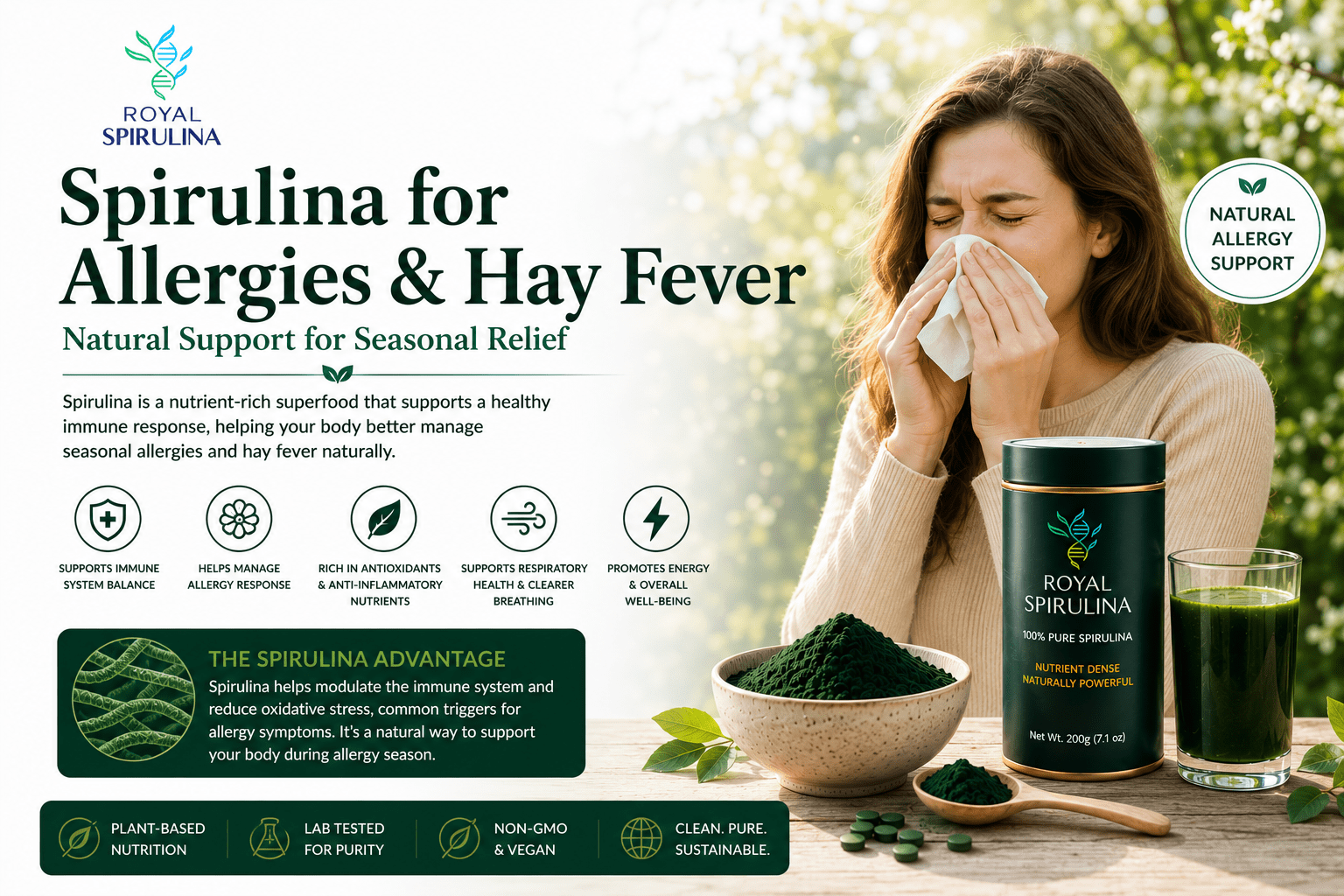
If you suffer from seasonal allergies or hay fever, you know the cycle all too well — sneezing fits, itchy eyes, nasal congestion, and a runny nose that no amount of tissue can keep up with. Over-the-counter antihistamines work, but they come with drowsiness, dry mouth, and the nagging question: is there a better way?
A growing body of peer-reviewed research suggests there might be. Spirulina — the nutrient-dense blue-green alga — has been studied in multiple randomized controlled trials for allergic rhinitis (the medical term for hay fever), and the results are remarkably consistent. From a landmark 2008 double-blind trial showing significant improvement across all four major allergy symptoms, to a 2020 head-to-head comparison with cetirizine (Zyrtec), the science is building a compelling case for spirulina as a natural allergy supplement.
In this article, we break down 9 PubMed-indexed studies, explain exactly how spirulina and its blue pigment phycocyanin fight allergic reactions at the cellular level, and share evidence-based dosage guidelines — so you can make an informed decision about adding spirulina to your allergy management plan.
What Is Allergic Rhinitis (Hay Fever)?
Allergic rhinitis — commonly called hay fever — is an inflammatory condition of the nasal passages triggered by airborne allergens such as pollen, dust mites, mold spores, and pet dander. When your immune system encounters these harmless substances, it overreacts by producing immunoglobulin E (IgE) antibodies, which trigger mast cells to release histamine and other inflammatory chemicals.
The result is the familiar constellation of symptoms: sneezing, nasal congestion, runny nose (rhinorrhea), itchy nose and eyes, postnasal drip, and fatigue. Allergic rhinitis affects an estimated 10–30% of the global population, and its prevalence continues to rise.
Conventional treatment relies on antihistamines, nasal corticosteroid sprays, and decongestants. While effective, these medications can cause side effects including drowsiness, dry mouth, headaches, and rebound congestion. Long-term use of some medications raises additional concerns. This is why researchers have increasingly turned their attention to natural alternatives — and spirulina has emerged as one of the most promising candidates.
How Spirulina Fights Allergies: The Science
Spirulina’s anti-allergy effects are not a single trick — they work through multiple, complementary mechanisms that address the allergic response at its roots rather than merely masking symptoms.
1. Suppressing IL-4 and Shifting the Th1/Th2 Balance
In allergic individuals, the immune system is skewed toward a “Th2-dominant” response. Th2 helper cells produce interleukin-4 (IL-4), which drives IgE production — the master switch of allergic reactions. A landmark 2005 randomized controlled trial at UC Davis found that spirulina at 2,000 mg/day reduced IL-4 production by 32% in allergic rhinitis patients, effectively suppressing the Th2 pathway that fuels allergy symptoms.
2. Inhibiting Histamine Release from Mast Cells
Histamine is the chemical directly responsible for sneezing, itching, and congestion. Phycocyanin — the blue pigment unique to spirulina — has been shown to directly inhibit histamine release from mast cells in a dose-dependent manner. Unlike antihistamines that block histamine after it’s released, phycocyanin prevents the release in the first place.
3. Blocking COX-2 and Reducing Inflammatory Mediators
Phycocyanin also inhibits cyclooxygenase-2 (COX-2), the enzyme that produces pro-inflammatory prostaglandins (PGE2) and leukotrienes (LTB4) in inflamed tissues. By reducing these inflammatory mediators, spirulina addresses the underlying inflammation — not just the histamine-driven symptoms.
4. Scavenging Reactive Oxygen Species (ROS)
Allergic inflammation generates a burst of reactive oxygen species that amplify tissue damage and swelling. Phycocyanin is a potent scavenger of hydroxyl, peroxyl, and alkoxyl radicals, as well as peroxynitrite and hypochlorous acid — providing antioxidant protection that complements its anti-inflammatory effects.
Key Clinical Studies on Spirulina and Allergies
The following table summarizes the most important peer-reviewed studies on spirulina and allergic rhinitis, all indexed on PubMed:
| Study (Year) | Design | Key Finding | PMID |
|---|---|---|---|
| Cingi et al. (2008) | Double-blind, placebo-controlled RCT | Spirulina significantly improved nasal discharge, sneezing, congestion & itching vs. placebo (P < 0.001) | 18343939 |
| Mao et al. (2005) | Randomized double-blind crossover RCT | 2,000 mg/day spirulina reduced IL-4 levels by 32%, suppressing Th2 differentiation | 15857205 |
| Nourollahian et al. (2020) | Single-blind RCT vs. cetirizine | Spirulina showed comparable efficacy to cetirizine for allergic rhinitis symptoms | 32773785 |
| Remirez et al. (2002) | In vivo & in vitro experimental | Phycocyanin inhibited histamine release from mast cells and reduced allergic ear edema | 12061428 |
| Liu et al. (2015) | In vivo (mice) & in vitro (mast cells) | Phycocyanin reduced IgE, histamine, IL-4 & IL-13; blocked Th2 polarization | 25746371 |
| Romay et al. (2003) | Review of 12 inflammation models | C-phycocyanin reduced histamine, PGE2, LTB4, and inhibited COX-2 in all 12 models | 12769719 |
| Karkos et al. (2006) | Systematic review | Spirulina’s positive effects on allergic rhinitis are “based on good levels of evidence” | 17125579 |
| Laccourreye et al. (2016) | Review (72 articles analyzed) | Spirulina shows “superiority over placebo” for rhinosinusitis and allergic rhinitis | 27914909 |
| Hon et al. (2015) | Review + patent analysis | Lists spirulina among herbal interventions with supportive evidence for allergic rhinitis | 26581315 |
The Cingi Trial: Spirulina vs. Placebo for Hay Fever
The most frequently cited study on spirulina and allergies is the 2008 double-blind, placebo-controlled trial by Cingi et al., published in the European Archives of Oto-Rhino-Laryngology. This rigorous trial evaluated spirulina’s effectiveness and tolerability in patients with allergic rhinitis.
The results were striking. Spirulina consumption significantly improved all four major allergy symptoms compared to placebo:
| Symptom | Spirulina Group | Placebo Group | Significance |
|---|---|---|---|
| Nasal discharge | Significantly improved | No significant change | P < 0.001 |
| Sneezing | Significantly improved | No significant change | P < 0.001 |
| Nasal congestion | Significantly improved | No significant change | P < 0.001 |
| Itching | Significantly improved | No significant change | P < 0.001 |
The researchers concluded that spirulina is “clinically effective on allergic rhinitis when compared with placebo” and called for further studies to clarify the mechanism of this effect.
Spirulina Reduces IL-4 and the Th2 Immune Response
To understand why spirulina works for allergies, we need to look at the immune system’s Th1/Th2 balance — and a groundbreaking 2005 study from UC Davis provides the answer.
In allergic individuals, the immune system overproduces Th2 helper cells, which secrete interleukin-4 (IL-4). IL-4 is the key cytokine that tells B cells to produce IgE antibodies — the antibodies that bind to mast cells and trigger the entire allergic cascade when you encounter pollen, dust, or pet dander.
Mao et al. conducted a randomized, double-blind crossover trial where allergic rhinitis patients received either placebo or spirulina at 1,000 mg/day or 2,000 mg/day for 12 weeks. The researchers then isolated peripheral blood mononuclear cells (PBMCs) and measured cytokine production.
The results showed that spirulina at 2,000 mg/day reduced IL-4 production by 32% from stimulated immune cells. This is significant because reducing IL-4 means less IgE production, fewer armed mast cells, and ultimately a weaker allergic response. Notably, the 1,000 mg dose was not as effective — suggesting that dosage matters when using spirulina for allergies.
The researchers wrote: “These results indicate that Spirulina can modulate the Th profile in patients with allergic rhinitis by suppressing the differentiation of Th2 cells mediated, in part, by inhibiting the production of IL-4.”
How Phycocyanin Blocks Histamine Release
Phycocyanin — the brilliant blue pigment that gives spirulina its characteristic color — is the compound most directly responsible for spirulina’s anti-allergy effects. Two key studies reveal exactly how it works.
Remirez et al. (2002) demonstrated in a series of elegantly designed experiments that phycocyanin inhibits allergic inflammatory responses through direct suppression of histamine release from mast cells. In sensitized mice, phycocyanin (100–300 mg/kg) significantly reduced both ear edema and myeloperoxidase activity triggered by allergen challenge. In isolated rat mast cells, phycocyanin inhibited compound 48/80-induced histamine release in a dose-dependent fashion.
The researchers concluded: “Inhibition of allergic inflammatory response by phycocyanin is mediated, at least in part, by inhibition of histamine release from mast cells.”
Liu et al. (2015) expanded on these findings, showing that phycocyanin from algae reduced IgE and histamine levels in antigen-sensitized mice, alleviated allergy symptoms and intestinal inflammation, and inhibited the release of IL-4 and IL-13. In IgE-sensitized mast cells, phycocyanin suppressed the release of beta-hexosaminidase (a degranulation marker), histamine, and reactive oxygen species.
Romay et al. (2003) provided the most comprehensive review, documenting phycocyanin’s anti-inflammatory effects across 12 different experimental models. Key findings include reduced histamine release, inhibition of COX-2 activity, lower levels of prostaglandin E2 (PGE2) and leukotriene B4 (LTB4), scavenging of hydroxyl, peroxyl, and alkoxyl radicals, and reduced TNF-alpha levels. These multiple mechanisms explain why spirulina can address the full spectrum of allergy symptoms — not just the histamine-driven ones.
Spirulina vs. Cetirizine (Zyrtec): A Head-to-Head Comparison
Perhaps the most clinically compelling evidence comes from a 2020 randomized trial by Nourollahian et al., published in Acta Otorhinolaryngologica Italica. This study directly compared spirulina to cetirizine (sold as Zyrtec or Reactine) — one of the most widely used antihistamines in the world.
The trial enrolled allergic rhinitis patients and randomized them to receive either spirulina or cetirizine 10 mg/day. Both groups were assessed for symptom improvement using validated scoring systems.
| Parameter | Spirulina | Cetirizine (Zyrtec) |
|---|---|---|
| Symptom improvement | Significant improvement | Significant improvement |
| Side effects | Minimal (well-tolerated) | Drowsiness, dry mouth possible |
| Mechanism | Multi-target (histamine, IL-4, COX-2, ROS) | Single-target (H1 receptor blocker) |
| Additional benefits | Nutritional value, antioxidant, immune modulation | Symptom relief only |
| Long-term use | Safe for extended use | Concerns about tolerance, dependency |
The finding that spirulina performed comparably to one of the world’s most popular antihistamines — without the typical side effects — is significant for allergy sufferers looking for a natural alternative. However, it’s important to note that spirulina is not a direct replacement for prescription allergy medications, and you should always consult your healthcare provider before making changes to your treatment plan.
Best Dosage of Spirulina for Allergies
Based on the clinical trials reviewed above, here are the evidence-based dosage guidelines for using spirulina for allergy relief:
| Purpose | Daily Dose | Evidence |
|---|---|---|
| Allergy symptom relief | 2,000 mg (2 g) per day | Cingi et al. RCT; Mao et al. RCT |
| IL-4 / immune modulation | 2,000 mg (2 g) per day | Mao et al. — 32% IL-4 reduction at this dose; 1,000 mg was ineffective |
| Prevention (pre-season) | 1,000–2,000 mg per day | Start 4–6 weeks before allergy season for best results |
| General maintenance | 1,000–3,000 mg per day | Well-tolerated across all clinical trials |
Key takeaway: The Mao et al. study showed that 1,000 mg/day was not effective at reducing IL-4, while 2,000 mg/day produced a significant 32% reduction. For allergy relief, 2,000 mg (2 grams) per day appears to be the minimum effective dose.
For a complete guide to spirulina dosing for different health goals, see our Spirulina Dosage Guide.
Why Freeze-Dried Spirulina Matters for Allergy Sufferers
Not all spirulina is created equal — and for allergy sufferers, the processing method can make or break the supplement’s effectiveness.
The anti-allergy benefits of spirulina come primarily from phycocyanin — the blue pigment that inhibits histamine release, reduces IL-4, and blocks COX-2. But phycocyanin is a protein, and proteins are highly sensitive to heat. This is where the difference between freeze-dried and spray-dried spirulina becomes critical.
Spray-dried spirulina (the majority of cheap spirulina imports, often from China) is processed at temperatures of 150–200°C (300–400°F). At these temperatures, phycocyanin denatures — meaning it loses its three-dimensional structure and, with it, its biological activity. Studies have shown that phycocyanin begins to degrade at temperatures above 60°C.
Freeze-dried spirulina (like Royal Spirulina) is processed at sub-zero temperatures, preserving the full spectrum of heat-sensitive compounds including phycocyanin, enzymes, and vitamins. The result is a product with significantly higher phycocyanin content and biological activity.
If you’re taking spirulina specifically for allergy relief, choosing a freeze-dried product is not optional — it’s essential. A spray-dried spirulina with degraded phycocyanin may deliver some nutritional value, but it won’t deliver the anti-allergy benefits demonstrated in the clinical trials.
Side Effects and Precautions
Spirulina is generally very well-tolerated. In the Cingi et al. trial, spirulina was described as having good “tolerability” with no significant adverse effects reported compared to placebo. However, there are a few precautions to keep in mind:
Autoimmune conditions: Because spirulina modulates the immune system (shifting Th1/Th2 balance), people with autoimmune conditions such as lupus, multiple sclerosis, or rheumatoid arthritis should consult their physician before use.
Anticoagulant medications: Spirulina has mild anticoagulant properties. If you take blood thinners such as warfarin, consult your doctor before adding spirulina.
Phenylketonuria (PKU): Spirulina contains phenylalanine, so individuals with PKU should avoid it.
Quality matters: Contaminated spirulina (grown in uncontrolled conditions) can contain heavy metals, microcystins, or other toxins. Always choose spirulina from reputable sources with third-party testing.
For a comprehensive list of interactions and precautions, see our guide: What to Avoid When Taking Spirulina.
Frequently Asked Questions
Does spirulina really help with allergies?
Yes. Multiple peer-reviewed studies, including a double-blind placebo-controlled trial (Cingi et al., 2008) and a head-to-head comparison with cetirizine (Nourollahian et al., 2020), demonstrate that spirulina significantly improves allergy symptoms including sneezing, nasal congestion, runny nose, and itching. The evidence is strong enough that systematic reviews have described it as being “based on good levels of evidence.”
How does spirulina help allergies?
Spirulina fights allergies through multiple mechanisms: its blue pigment phycocyanin inhibits histamine release from mast cells, reduces production of the allergy-driving cytokine IL-4 by 32% (at 2 g/day), blocks the COX-2 enzyme that produces inflammatory prostaglandins, and scavenges reactive oxygen species that amplify allergic inflammation. This multi-target approach addresses the root cause of allergies, not just the symptoms.
How much spirulina should I take for hay fever?
Based on clinical trial data, the minimum effective dose for allergy relief is 2,000 mg (2 grams) per day. The Mao et al. study at UC Davis showed that 1,000 mg/day was not effective at reducing IL-4 (the key allergy cytokine), while 2,000 mg/day produced a significant 32% reduction. For best results, start 4–6 weeks before your allergy season begins.
Can spirulina replace antihistamines like Zyrtec?
A 2020 clinical trial (Nourollahian et al.) showed spirulina performed comparably to cetirizine (Zyrtec) for allergic rhinitis symptoms. However, spirulina is a dietary supplement, not a medication, and should not replace prescribed allergy treatments without consulting your healthcare provider. Many people find spirulina works well as a complementary approach alongside conventional treatments.
How long does it take for spirulina to work for allergies?
The clinical trials that showed significant allergy symptom improvement used spirulina for 12 weeks. Some users report noticeable improvements within 2–4 weeks. For seasonal allergies, starting spirulina 4–6 weeks before your peak allergy season allows time for the immune-modulating effects to build up.
Is spirulina safe to take with allergy medications?
Spirulina is generally considered safe to take alongside most allergy medications, as it works through different mechanisms than antihistamines and nasal steroids. However, because spirulina modulates the immune system, you should consult your doctor if you take immunosuppressant medications or have an autoimmune condition. Always inform your healthcare provider about all supplements you take.
What is the best form of spirulina for allergies?
Freeze-dried spirulina is the best choice for allergy sufferers because it preserves the highest levels of phycocyanin — the compound responsible for spirulina’s anti-histamine and anti-inflammatory effects. Spray-dried spirulina (commonly imported from China) is processed at high temperatures that can denature phycocyanin, reducing its anti-allergy activity. Look for third-party tested, freeze-dried spirulina for maximum benefit.
Can children take spirulina for allergies?
While the clinical trials on spirulina and allergic rhinitis were conducted in adults, spirulina is generally considered safe for children in appropriate doses. A typical dose for children ages 5–12 is 500–1,000 mg/day. However, always consult your pediatrician before giving spirulina or any supplement to children, especially those with allergies or immune conditions.
Scientific References
- Cingi C, Conk-Dalay M, Cakli H, Bal C. “The effects of spirulina on allergic rhinitis.” Eur Arch Otorhinolaryngol. 2008;265(10):1219-23. DOI: 10.1007/s00405-008-0642-8 (PMID: 18343939)
- Mao TK, Van de Water J, Gershwin ME. “Effects of a Spirulina-based dietary supplement on cytokine production from allergic rhinitis patients.” J Med Food. 2005;8(1):27-30. DOI: 10.1089/jmf.2005.8.27 (PMID: 15857205)
- Nourollahian M, Rasoulian B, Gafari A, et al. “Clinical comparison of the efficacy of spirulina platensis and cetirizine for treatment of allergic rhinitis.” Acta Otorhinolaryngol Ital. 2020;40(3):224-229. DOI: 10.14639/0392-100X-N0139 (PMID: 32773785)
- Remirez D, Ledon N, Gonzalez R. “Role of histamine in the inhibitory effects of phycocyanin in experimental models of allergic inflammatory response.” Mediators Inflamm. 2002;11(2):81-5. DOI: 10.1080/09629350220131926 (PMID: 12061428)
- Liu Q, Wang Y, Cao M, et al. “Anti-allergic activity of R-phycocyanin from Porphyra haitanensis in antigen-sensitized mice and mast cells.” Int Immunopharmacol. 2015;25(2):465-73. DOI: 10.1016/j.intimp.2015.02.032 (PMID: 25746371)
- Romay Ch, Gonzalez R, Ledon N, Remirez D, Rimbau V. “C-phycocyanin: a biliprotein with antioxidant, anti-inflammatory and neuroprotective effects.” Curr Protein Pept Sci. 2003;4(3):207-16. DOI: 10.2174/1389203033487216 (PMID: 12769719)
- Karkos PD, Leong SC, Arya AK, et al. “‘Complementary ENT’: a systematic review of commonly used supplements.” J Laryngol Otol. 2006;121(8):779-82. DOI: 10.1017/S002221510600449X (PMID: 17125579)
- Laccourreye O, Werner A, Laccourreye L, Bonfils P. “Benefits, pitfalls and risks of phytotherapy in clinical practice in otorhinolaryngology.” Eur Ann Otorhinolaryngol Head Neck Dis. 2016;134(2):95-99. DOI: 10.1016/j.anorl.2016.11.001 (PMID: 27914909)
- Hon KL, Fung CK, Leung AKC, Lam HS, Lee SL. “Recent Patents of Complementary and Alternative Medicine for Allergic Rhinitis.” Recent Pat Inflamm Allergy Drug Discov. 2015;9(2):107-19. DOI: 10.2174/1872213×10666151119144718 (PMID: 26581315)
Related Reading
Spirulina Benefits: Complete Guide to Health Benefits — Comprehensive overview of all evidence-based spirulina health benefits.
Blue Spirulina Benefits: The Power of Phycocyanin — Deep dive into phycocyanin, the blue pigment responsible for spirulina’s anti-allergy effects.
Spirulina Side Effects: What You Need to Know — Complete guide to potential side effects and who should avoid spirulina.
What to Avoid When Taking Spirulina — Drug interactions, contraindications, and safety precautions.
Spirulina Dosage Guide: How Much Should You Take? — Evidence-based dosage recommendations for different health goals.
Freeze-Dried vs. Spray-Dried Spirulina — Why processing method matters for phycocyanin content and biological activity.
Spirulina and Chlorella Together: Benefits of Combining Both — How combining spirulina with chlorella may enhance overall health benefits.
Spirulina Benefits for Women — Gender-specific benefits including immune health and inflammation reduction.
Spirulina for Heart Health: Cholesterol & Blood Pressure — How spirulina’s anti-inflammatory properties extend to cardiovascular health.
Does Spirulina Have Vitamin B12? — What the science says about spirulina’s vitamin B12 content.