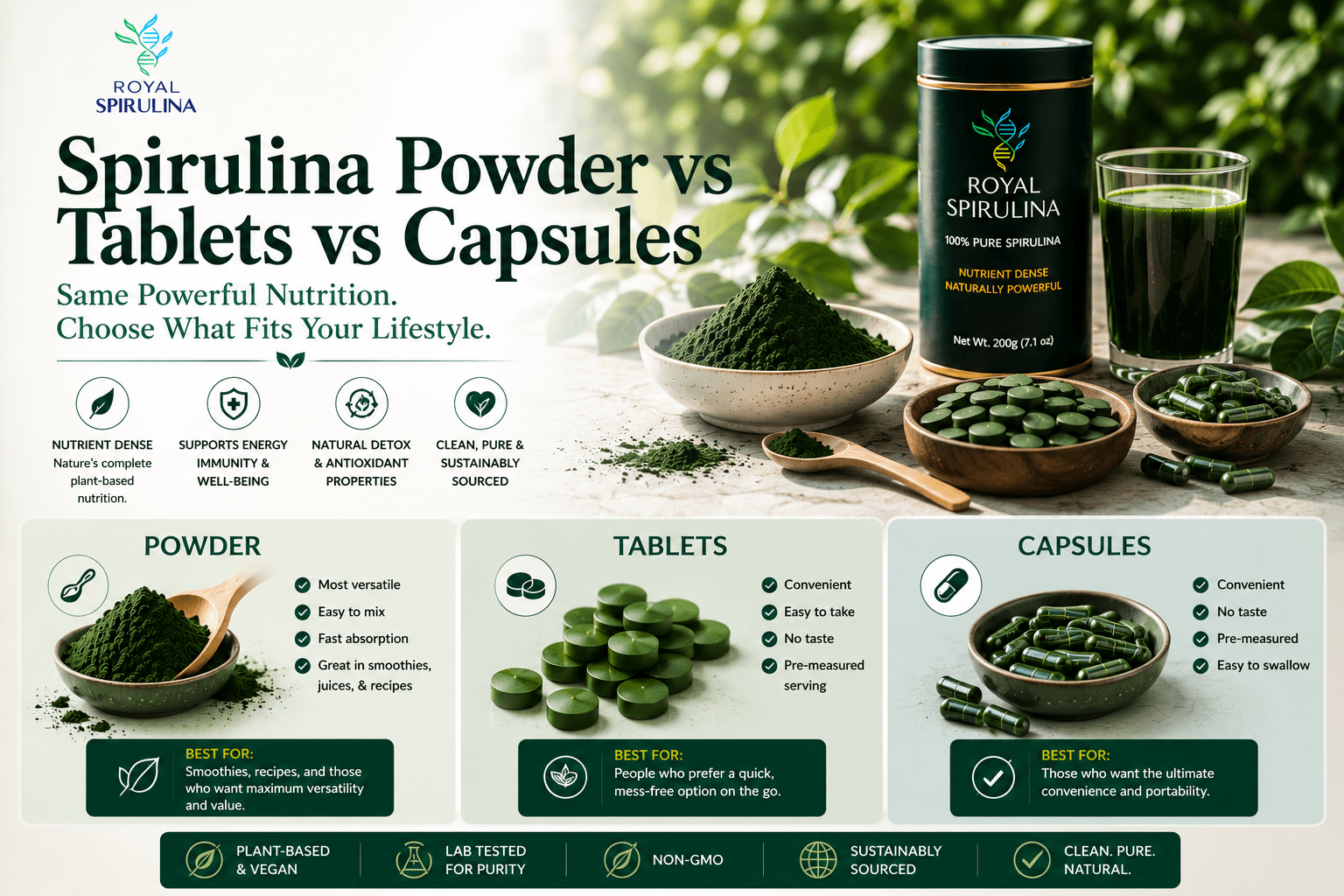
Walk into any health food store or browse online for spirulina, and you’ll find three main options: powder, tablets, and capsules. They all claim to offer the same benefits, but here’s what most supplement companies won’t tell you — the form you choose dramatically affects how much active nutrition you actually absorb, and the quality gap between these products is enormous.
The uncomfortable truth is that the vast majority of spirulina tablets and capsules sold worldwide are mass-produced imports from China, spray-dried at high temperatures, compressed with chemical binding agents, and contain significantly less bioactive nutrition than the label suggests. Meanwhile, freeze-dried spirulina powder — while less convenient — preserves virtually all of the compounds that make spirulina worth taking in the first place.
In this comprehensive guide, we break down the real differences between spirulina powder, tablets, and capsules — backed by published research on processing methods, bioavailability, contamination risks, and what to look for when choosing your daily spirulina.
Quick Comparison: Powder vs Tablets vs Capsules
| Factor | Powder | Tablets | Capsules |
|---|---|---|---|
| Phycocyanin retention | Highest (freeze-dried) | Lowest (heat + compression) | Moderate |
| Fillers and binders | None (100% spirulina) | Yes (5-20% of tablet weight) | Minimal (capsule shell only) |
| Absorption speed | Fastest (immediate) | Slowest (must dissolve) | Moderate |
| Dosing flexibility | Fully adjustable | Fixed per tablet | Fixed per capsule |
| Spirulina per serving | 3-5g easily | 500mg typical (need 6-10 tablets for 3-5g) | 500-750mg typical (need 4-10 capsules) |
| Convenience | Requires mixing | Most convenient | Convenient |
| Taste | Strong (earthy/algal) | Minimal | None |
| Cost per gram of spirulina | Lowest | Highest (factoring fillers) | Moderate to high |
| Typical origin | Varies (check source) | Mostly China (mass-produced) | Mostly China (mass-produced) |
The Problem with Spirulina Tablets
Spirulina tablets are the most popular form sold worldwide — and unfortunately, they’re also the lowest quality form you can buy. Here’s why:
1. Binding Agents and Fillers Reduce What You’re Actually Getting
To press loose spirulina powder into a hard tablet that holds its shape, manufacturers must add binding agents, flow agents, and fillers. Common tablet excipients include magnesium stearate (a flow agent), silicon dioxide (anti-caking), microcrystalline cellulose (bulk filler), maltodextrin, stearic acid, and dicalcium phosphate. These non-spirulina ingredients typically make up 5 to 20 percent of the tablet weight.
This means when a label says “500mg spirulina tablet,” you may only be getting 400-475mg of actual spirulina — the rest is industrial filler. Over a bottle of 200 tablets, you’re paying for spirulina but receiving significant amounts of inactive ingredients with zero nutritional value.
2. High-Pressure Compression Damages Phycocyanin
Tablet manufacturing requires spirulina powder to be compressed under extreme mechanical pressure — typically 10,000 to 30,000 pounds per square inch. This compression, combined with the friction heat generated during pressing, further damages the already heat-sensitive phycocyanin molecule.
According to PubMed research, phycocyanin is highly sensitive to environmental factors including temperature, light, and mechanical stress. A 2025 study published in Molecules demonstrated that freeze-drying preserved phycocyanin with a thermal decomposition temperature increase of 22 to 23 degrees Celsius, while conventional spray-drying only achieved 8 to 11 degrees Celsius improvement — meaning spray-dried material is already significantly degraded before the tablet pressing even begins (PMID: 40142077; DOI: 10.3390/molecules30061303).
3. Most Tablets Are Imported from China — with Serious Quality Concerns
The majority of spirulina tablets sold in Western markets are manufactured in China, where the spirulina industry produces hundreds of thousands of tonnes annually in massive open-pond facilities. While some Chinese producers maintain adequate standards, the economic pressure to minimize costs has created widespread quality issues:
- Spray-drying is universal. Chinese bulk spirulina is almost exclusively spray-dried at 150-200 degrees Celsius to maximize throughput. This destroys 30-60% of phycocyanin content before the product even leaves the factory.
- Open-pond contamination. According to a 2023 study published in Microorganisms, commercial spirulina supplements produced in open ponds contained microcystin toxins in ALL products tested, at levels that could lead consumers to exceed recommended daily limits. Potentially pathogenic bacteria including Bacillus cereus were also detected (PMID: 37317149; DOI: 10.3390/microorganisms11051175).
- Heavy metal contamination. A 2020 study in Toxins found that microalgae supplements contained microcystin-LR, anatoxin-a, and high concentrations of heavy metals, particularly lead. Both cyanophyte and chlorophyte products were affected (PMID: 32872271; DOI: 10.3390/toxins12090552).
- Inaccurate labeling. A 2022 analytical study of commercially available spirulina supplements found that 86.7% had inappropriate declarations regarding their elemental content — meaning what’s on the label doesn’t match what’s in the product. The presence of additives resulted in significant variation in nutrient content and lower product quality (PMID: 35327271; DOI: 10.3390/foods11060849).
4. Slow Dissolution Means Slower Absorption
Compressed tablets must physically break apart in your digestive system before the nutrients can be absorbed. Hard-pressed spirulina tablets can take 30 to 60 minutes to fully dissolve in stomach acid, compared to powder which begins absorption almost immediately upon contact with digestive juices. For people with compromised digestive function or low stomach acid, tablets may pass through partially undissolved.
Spirulina Capsules: A Better Alternative to Tablets?
Capsules solve some of the tablet’s problems but introduce others:
Advantages over tablets:
- No high-pressure compression — the spirulina inside remains as loose powder
- No need for binding agents or flow agents in significant quantities
- The gelatin or vegetable (HPMC) capsule shell dissolves quickly
- No taste (the shell completely masks spirulina’s flavor)
Remaining problems:
- Low dose per capsule. A standard “00” capsule holds approximately 500-750mg of powder. To achieve a clinically effective dose of 3-5 grams, you need to swallow 4 to 10 capsules per serving — impractical and expensive.
- Same sourcing issues. Most capsule products use the same spray-dried Chinese bulk spirulina as tablets. The capsule shell doesn’t fix the underlying quality of what’s inside it.
- Higher cost per gram. The encapsulation process, capsule materials, and reduced fill weight make capsules more expensive per gram of actual spirulina compared to powder.
- Limited transparency. You can’t see, smell, or taste the powder inside a capsule — making it harder to assess quality. High-quality spirulina has a deep green color and characteristic smell; low-quality products look dull or brownish-green.
Why Powder Is the Superior Form
For anyone serious about getting the full benefit of daily spirulina supplementation, powder is objectively the superior delivery form. Here’s why:
100% Spirulina — No Fillers, No Exceptions
When you buy spirulina powder, you’re getting exactly what you pay for — pure spirulina with nothing else added. Every gram contains the full spectrum of phycocyanin, beta-carotene, chlorophyll, GLA, complete protein, iron, B vitamins, and other bioactive compounds. There are no binding agents diluting the product.
Maximum Phycocyanin Preservation (When Freeze-Dried)
The key distinction isn’t just powder vs. tablets — it’s the drying method used to process the spirulina. According to published research, freeze-drying achieves 67 to 78% phycocyanin encapsulation efficiency while conventional spray-drying achieves only 38 to 42% — meaning freeze-dried powder retains nearly twice the bioactive phycocyanin of spray-dried products (PMID: 40142077; DOI: 10.3390/molecules30061303).
A 2020 study in Food Technology and Biotechnology confirmed that freeze-dried phycocyanin achieved approximately 99% encapsulation efficiency with enhanced thermal stability and preserved antioxidant properties — far superior to heat-based drying methods (PMID: 33505205; DOI: 10.17113/ftb.58.04.20.6622).
Fastest Absorption
Spirulina powder begins releasing its nutrients the moment it contacts your digestive system. There’s no tablet to dissolve, no capsule shell to break down. This means faster absorption and potentially higher bioavailability of time-sensitive compounds like phycocyanin and the water-soluble B vitamins.
Flexible Dosing
With powder, you can easily adjust your daily dose from 1 gram to 10+ grams without swallowing handfuls of pills. Clinical studies use doses ranging from 1 to 6 grams per day depending on the health goal (see our spirulina dosage guide). With tablets at 500mg each, achieving a 6-gram therapeutic dose requires swallowing 12 tablets — absurd and expensive.
Visual Quality Verification
You can immediately assess powder quality by its color, smell, and texture. High-quality freeze-dried spirulina is a vivid deep green with hints of blue-green (from intact phycocyanin). Low-quality spray-dried spirulina appears dull olive-green or brownish-green. You simply can’t make this assessment with tablets or capsules.
The Processing Problem: Spray-Dried vs. Freeze-Dried
Regardless of whether spirulina is sold as powder, tablets, or capsules, the processing method is the single most important factor determining nutritional quality. Here’s what happens to spirulina under different drying methods:
| Property | Spray-Dried (Most Tablets/Capsules) | Freeze-Dried (Premium Powder) |
|---|---|---|
| Processing temperature | 150-200°C | -40 to -80°C (under vacuum) |
| Phycocyanin retention | 40-70% (30-60% lost) | 90-99% preserved |
| Thermal stability improvement | +8-11°C decomposition temp | +22-23°C decomposition temp |
| Enzyme activity | Largely destroyed | Preserved |
| Beta-carotene | Partially degraded | Fully preserved |
| GLA (gamma-linolenic acid) | Oxidized at high temps | Protected from oxidation |
| Production cost | Low (high throughput) | Higher (slower, energy-intensive) |
| Typical use | Cheap bulk exports (China, India) | Premium supplements (limited producers) |
For a comprehensive comparison of these processing methods, see our detailed guide: Freeze-Dried vs. Spray-Dried Spirulina.
Quality and Safety Concerns with Imported Spirulina Products
Multiple peer-reviewed studies have documented serious quality and safety issues with commercially available spirulina supplements — the vast majority of which are tablets and capsules sourced from Chinese mass-production facilities:
Microcystin Contamination
Microcystins are potent liver toxins produced by contaminating cyanobacteria that can co-occur in spirulina cultivation ponds. According to PubMed research:
- A 2023 study found microcystin toxins in ALL commercial spirulina products tested, at levels that could lead consumers to exceed recommended daily intake limits (PMID: 37317149).
- A 2022 Belgian market study found microcystin congeners in 9 out of 35 algal food supplements, with 3 exceeding the proposed guideline value of 1 microg/g (PMID: 36006175; DOI: 10.3390/toxins14080513).
- A 2025 analysis using advanced UHPLC-MS detected multiple cyanotoxins in spirulina-based food supplements, with high concentrations of microcystin-RR in some products (PMID: 40941085; DOI: 10.3390/foods14172969).
Heavy Metal Contamination
Open-pond cultivation — the standard method for Chinese mass production — leaves spirulina vulnerable to environmental contamination. Studies have documented elevated levels of lead, mercury, arsenic, and cadmium in retail spirulina supplements (PMID: 32872271; DOI: 10.3390/toxins12090552). A comprehensive review confirms that heavy metal contamination is a known risk with mass-produced cyanobacterial supplements (PMID: 32749124; DOI: 10.1615/JEnvironPatholToxicolOncol.2020034375).
Mislabeling and Adulteration
The 2022 Slovenian market study revealed that 86.7% of spirulina supplements had inaccurate nutritional declarations. The addition of fillers and excipients resulted in significant variation in actual nutrient content compared to labeled values. Iron content was particularly misleading — while total iron appeared high, it was primarily in the less bioavailable ferric form (PMID: 35327271; DOI: 10.3390/foods11060849).
What to Look for When Choosing Spirulina
Whether you choose powder, tablets, or capsules, these are the critical factors that determine whether you’re getting a quality product:
- Processing method. Look for “freeze-dried” on the label. If it says “spray-dried” or doesn’t specify, assume spray-dried. This is the single biggest quality indicator.
- Country of origin. Know where your spirulina was cultivated and processed. Controlled-environment production in established facilities with proper testing is essential.
- Third-party testing. Look for certificates of analysis (COA) showing tests for microcystins, heavy metals (lead, mercury, arsenic, cadmium), and pathogenic bacteria.
- Phycocyanin content. Premium products will state their phycocyanin content (measured in mg/g or as a percentage). Higher phycocyanin = better quality spirulina.
- Color. Deep vibrant green (with blue-green hints) = high phycocyanin and chlorophyll. Dull olive or brownish-green = degraded product.
- Ingredient list. For tablets: check for binding agents (magnesium stearate, silicon dioxide, microcrystalline cellulose). For capsules: check the shell material (vegetable HPMC is preferable to gelatin for most people).
- Price per gram. Quality spirulina costs more to produce. If a product seems remarkably cheap, it’s almost certainly mass-produced spray-dried Chinese bulk product with questionable testing.
Royal Spirulina: Freeze-Dried Powder for Maximum Benefit
Royal Spirulina is freeze-dried — processed at extremely low temperatures under vacuum to preserve virtually all of the original phycocyanin, enzymes, beta-carotene, chlorophyll, and other heat-sensitive bioactive compounds. Unlike the spray-dried Chinese imports that dominate the tablet and capsule market, Royal Spirulina maintains the full nutritional integrity that makes spirulina supplementation worthwhile.
When research studies demonstrate spirulina’s benefits for cholesterol and blood pressure, liver health, daily wellness, and athletic performance, they’re measuring the effects of high-quality, bioactive spirulina — not degraded spray-dried products that have lost half their phycocyanin before they even reach your body.
How to Use Spirulina Powder
The most common objection to powder is taste and convenience. Here are practical ways to incorporate spirulina powder into your daily routine:
- Smoothies. The most popular method — 1 to 2 teaspoons blended with banana, mango, or pineapple completely masks the taste.
- Juice. Stir into orange juice, apple juice, or cold-pressed green juice.
- Water + lemon. For the no-fuss approach: mix with cold water and a squeeze of lemon. Fast, simple, effective.
- Food. Mix into hummus, guacamole, salad dressings, or energy balls.
- Yogurt. Stir into plain yogurt with honey or fruit.
For more ideas, see our guide on best time to take spirulina. The key is consistency — daily use at an effective dose matters more than the specific method.
Frequently Asked Questions
Is spirulina powder better than tablets?
Yes, for three reasons: powder contains 100% spirulina with no fillers or binding agents, it absorbs faster since there’s no tablet to dissolve, and freeze-dried powder preserves significantly more phycocyanin than the spray-dried spirulina used in most tablets. The only advantage of tablets is convenience — but at the cost of reduced potency, fillers, and typically lower overall quality.
Why are most spirulina tablets low quality?
The vast majority of spirulina tablets are made from spray-dried Chinese bulk spirulina that has already lost 30-60% of its phycocyanin during high-temperature drying. The tableting process then adds binding agents (5-20% of tablet weight) and further damages nutrients through high-pressure compression. Multiple studies have found microcystin contamination, heavy metals, and inaccurate labeling in commercial spirulina supplements. The economic incentives of mass production prioritize cost over quality.
Are spirulina capsules better than tablets?
Capsules are somewhat better than tablets because they avoid the high-pressure compression that damages phycocyanin, and they require fewer binding agents. However, capsules still typically contain the same spray-dried Chinese bulk spirulina, offer low doses per capsule (requiring many capsules per day), and cost more per gram than powder. If you prefer not to taste spirulina, capsules are a better choice than tablets, but powder remains the optimal form for potency and value.
How many spirulina tablets equal one teaspoon of powder?
One teaspoon of spirulina powder contains approximately 3 grams. Since most spirulina tablets contain 500mg each (minus fillers, so approximately 400-475mg of actual spirulina), you would need 6 to 8 tablets to equal one teaspoon of pure powder. For the clinically effective dose of 3-5 grams used in most research studies, you’d need 6-10 tablets per day.
Can spirulina tablets be contaminated?
Yes. Published research has documented contamination of commercial spirulina supplements with microcystin toxins, heavy metals (particularly lead), and pathogenic bacteria. A 2023 study found microcystins in all commercial products tested, while a 2022 study found 86.7% of products had inaccurate nutritional declarations. The risk is highest with products from unknown manufacturers using open-pond cultivation without rigorous third-party testing. Look for products with certificates of analysis from accredited laboratories.
What is the best form of spirulina to take?
Freeze-dried powder is the best form for maximum nutrition and bioavailability. It contains 100% spirulina with no fillers, preserves the most phycocyanin (the key bioactive compound), absorbs fastest, allows flexible dosing, and costs the least per gram of actual spirulina. The critical factor isn’t just the form (powder vs. tablet vs. capsule) — it’s the processing method. Freeze-dried spirulina preserves 22-23°C higher thermal decomposition stability than spray-dried, indicating vastly superior retention of heat-sensitive nutrients.
How do I know if my spirulina is from China?
Check the product label for “country of origin” or “manufactured in” statements. If it says “Product of China,” “Manufactured in China,” or lists a Chinese city or province, it’s Chinese-sourced. Many brands don’t clearly disclose origin — in those cases, extremely low prices (under $15-20 per 100g) almost always indicate Chinese bulk spray-dried product. Reputable brands will clearly state where their spirulina is cultivated, processed, and tested.
Is it worth paying more for freeze-dried spirulina?
Absolutely. The price difference between freeze-dried and spray-dried spirulina reflects a genuine and significant quality difference. Freeze-dried spirulina retains nearly twice the phycocyanin of spray-dried product (the compound responsible for most of spirulina’s researched health benefits). If you’re taking spirulina for its clinically proven effects on cholesterol, blood pressure, antioxidant capacity, or immune function, those benefits depend on the phycocyanin actually being present and active in the product you consume. Cheap spray-dried tablets deliver a fraction of the bioactive nutrition.
Scientific References
- Navikaitė-Šnipaitienė V, Liudvinavičiūtė D, Rutkaitė R, et al. Antioxidant capacity and thermal stability of Arthrospira extract encapsulated in starch sodium octenyl succinate with freeze-, spray-, and nanospray-drying. Molecules. 2025;30(6):1303. PMID: 40142077. DOI: 10.3390/molecules30061303.
- Pan-Utai W, Iamtham S. Enhanced microencapsulation of C-phycocyanin from Arthrospira by freeze-drying with different wall materials. Food Technology and Biotechnology. 2020;58(4):423-432. PMID: 33505205. DOI: 10.17113/ftb.58.04.20.6622.
- Akbarbaglu Z, Tamjidi F, Sarabandi K, et al. Stabilization of Arthrospira phycocyanin within structurally modified whey protein: thermal, biological, and photo-stability. International Journal of Biological Macromolecules. 2025;329(Pt 2):147920. PMID: 41015353. DOI: 10.1016/j.ijbiomac.2025.147920.
- Rhoades J, Fotiadou S, Paschalidou G, et al. Microbiota and cyanotoxin content of retail spirulina supplements and spirulina supplemented foods. Microorganisms. 2023;11(5):1175. PMID: 37317149. DOI: 10.3390/microorganisms11051175.
- Masten Rutar J, Jagodic Hudobivnik M, Nečemer M, et al. Nutritional quality and safety of the dietary supplements sold on the Slovenian market. Foods. 2022;11(6):849. PMID: 35327271. DOI: 10.3390/foods11060849.
- Van Hassel WHR, Ahn AC, Huybrechts B, et al. LC-MS/MS validation and quantification of cyanotoxins in algal food supplements from the Belgium market. Toxins. 2022;14(8):513. PMID: 36006175. DOI: 10.3390/toxins14080513.
- Carbonell-Rozas L, Aparicio-Muriana MM, Romero-González R, et al. Application of targeted and suspect screening workflows for cyclic peptide cyanotoxin profiling in spirulina- and klamath-based food supplements. Foods. 2025;14(17):2969. PMID: 40941085. DOI: 10.3390/foods14172969.
- Sánchez-Parra E, Boutarfa S, Aboal M. Are cyanotoxins the only toxic compound potentially present in microalgae supplements? Toxins. 2020;12(9):552. PMID: 32872271. DOI: 10.3390/toxins12090552.
- Bhattacharya S. The role of Spirulina (Arthrospira) in the mitigation of heavy-metal toxicity: an appraisal. Journal of Environmental Pathology, Toxicology and Oncology. 2020;39(2):149-157. PMID: 32749124. DOI: 10.1615/JEnvironPatholToxicolOncol.2020034375.
Related Reading
Freeze-Dried vs. Spray-Dried Spirulina: The Complete Guide — Detailed comparison of processing methods and their impact on nutritional quality.
Spirulina Dosage Guide — Evidence-based doses for every health goal, and how form affects effective dosing.
What Happens If You Take Spirulina Every Day — Week-by-week timeline of benefits from consistent daily spirulina use.
Blue Spirulina & Phycocyanin Benefits — Why phycocyanin preservation is the key quality marker for any spirulina product.
The Science-Based Guide to Spirulina Benefits — Complete overview of evidence-based benefits you can only achieve with quality spirulina.
Spirulina Side Effects — How product quality affects side effects, and what to watch for with low-quality products.
What to Avoid When Taking Spirulina — Interactions, contraindications, and quality red flags.
Spirulina Protein: The Complete Guide — Protein content and bioavailability across different spirulina forms.
Best Time to Take Spirulina — Optimal timing for powder vs. tablets vs. capsules.
Spirulina vs Chlorella — How these two superfoods compare across different supplement forms.