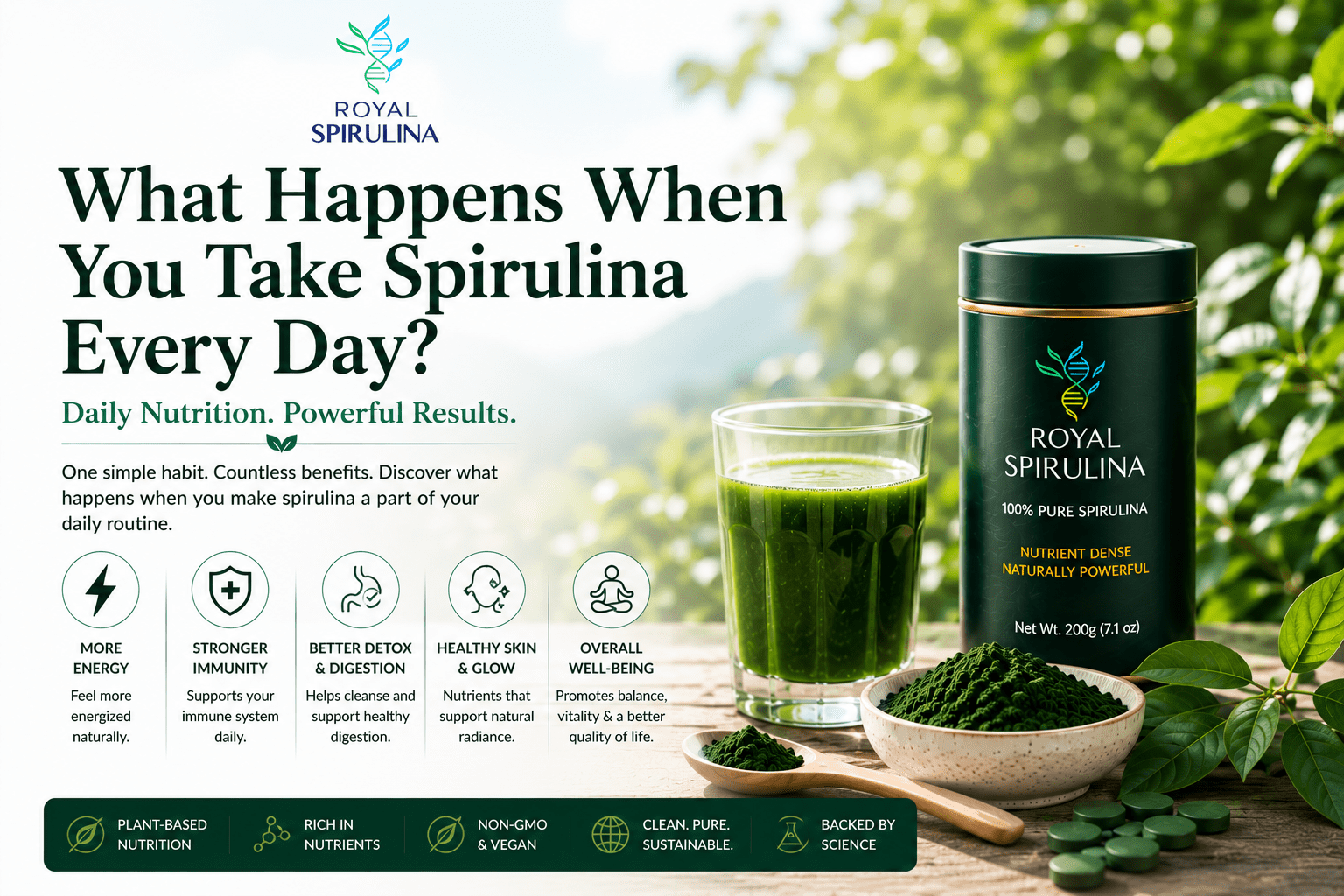
If you’ve been curious about spirulina but haven’t committed to daily use, you’re probably wondering: what actually happens to your body if you take spirulina every day? Is it worth making part of your routine, or is it just another overhyped supplement?
The short answer is that daily spirulina supplementation produces measurable, cumulative benefits that build over time. Unlike many supplements where effects are subtle or debatable, spirulina has been studied in over 100 human clinical trials — and the research consistently shows that its benefits are dose-dependent and duration-dependent. The longer and more consistently you take it, the more pronounced the results.
In this guide, we walk through what the science says happens at each stage of daily spirulina use — from the first week through six months and beyond — based on published human clinical trials and systematic reviews. We also cover the optimal daily dose, what to expect (and what not to expect), and how to get the most out of your daily spirulina habit.
Week 1: What Happens in the First Few Days
During your first week of daily spirulina supplementation, the most noticeable changes are related to energy and digestion. Many new users report a subtle boost in alertness and sustained energy, particularly when taking spirulina in the morning. This is likely due to spirulina’s concentrated nutrient density — a single 3-gram serving provides significant amounts of iron, B vitamins (particularly B1, B2, and B3), and highly bioavailable complete protein.
You may also notice mild digestive changes as your gut microbiome begins to adjust. According to PubMed research, spirulina has demonstrated prebiotic properties, enhancing the proliferation of beneficial bacteria such as Lactobacillus acidophilus and positively modulating intestinal microbial composition in human gut models (PMID: 35337549; DOI: 10.1016/j.foodres.2021.110880). Some people experience mild bloating or gas during the first few days — this typically resolves within 3 to 5 days as your digestive system adapts.
What to expect in Week 1:
- Subtle energy improvement (especially mornings)
- Possible mild digestive adjustment (temporary)
- Green-colored stool (harmless — caused by chlorophyll)
- Slightly reduced appetite in some people (due to high protein content)
Tip: Start with 1 to 2 grams per day during the first week and increase gradually. Taking spirulina with food reduces any digestive sensitivity. For detailed timing advice, see our guide on the best time to take spirulina.
Weeks 2 to 4: Antioxidant Defense Kicks In
By the second to fourth week of consistent daily use, spirulina’s antioxidant defense systems begin to produce measurable biological effects. The key compound responsible is phycocyanin — the blue pigment unique to spirulina that activates the Nrf2/HO-1 antioxidant pathway, your body’s master regulator of cellular protection.
According to a comprehensive 2026 review published in Molecules, spirulina supplementation activates three central regulatory pathways: Nrf2-dependent antioxidant responses, NF-kB inflammatory signaling suppression, and AMPK/AKT metabolic pathway modulation (PMID: 42197149; DOI: 10.3390/molecules31101595). These pathways don’t activate overnight — they require consistent daily exposure to build cumulative protective effects.
What happens during Weeks 2 to 4:
- Nrf2 pathway activation increases production of protective enzymes (SOD, catalase, glutathione peroxidase)
- NF-kB inflammatory signaling begins to be suppressed
- Total antioxidant capacity in your blood starts to rise
- Skin may begin to look more vibrant (phycocyanin + beta-carotene protect skin cells from UV and oxidative damage)
- Allergy symptoms may begin to lessen
- Exercise recovery may improve
A 2024 randomized controlled trial in patients with ulcerative colitis demonstrated that just 1 gram per day of spirulina for 8 weeks significantly increased serum total antioxidant capacity compared to placebo (PMID: 38424572; DOI: 10.1186/s12906-024-04400-w). This confirms that even modest daily doses produce measurable improvements in your body’s antioxidant defenses within weeks.
For athletes and active people, a 2018 study on elite Polish rowers found that 6 weeks of daily spirulina extract (1,500 mg) protected immune function against the suppressive effects of intense training — preventing the post-exercise immune deficit that makes athletes vulnerable to infections (PMID: 29467598; DOI: 10.1186/s12970-018-0213-3). Learn more in our guide on spirulina for athletes.
Months 1 to 3: Cholesterol, Blood Pressure, and Blood Sugar Respond
The one- to three-month mark is where daily spirulina use begins to produce the most clinically significant and measurable health improvements. This is the timeframe used in the majority of successful human clinical trials, and it’s when blood markers of cardiovascular and metabolic health start to shift meaningfully.
Cholesterol and Triglycerides Drop
A 2021 triple-blind randomized controlled trial demonstrated that just 2 grams of spirulina per day for 8 weeks significantly reduced systolic blood pressure, diastolic blood pressure, triglycerides, total cholesterol, and LDL cholesterol in patients with hypertension (PMID: 34542204; DOI: 10.1002/ptr.7254).
A 2025 systematic review and meta-analysis of randomized controlled trials confirmed that spirulina supplementation produces a significant reduction in diastolic blood pressure and shows a trend toward total cholesterol reduction (PMID: 40289965; DOI: 10.3390/nu17060943). For a deep dive into the cardiovascular evidence, see our article on spirulina for heart health.
Blood Sugar Improves
For people with elevated blood sugar or type 2 diabetes, daily spirulina produces dramatic improvements. A 2023 randomized, double-blind, placebo-controlled trial found that 2 grams of spirulina per day for 3 months (added to standard metformin therapy) reduced HbA1c by 1.43 points and fasting blood sugar by 24.94 mg/dL — improvements that are clinically significant and comparable to adding a second pharmaceutical drug (PMID: 36598187; DOI: 10.1002/ptr.7674).
A 2021 meta-analysis of 8 clinical trials further confirmed that spirulina supplementation significantly reduces fasting blood glucose (-17.88 mg/dL), triglycerides (-30.99 mg/dL), total cholesterol (-18.47 mg/dL), and LDL cholesterol (-20.04 mg/dL) in type 2 diabetes patients (PMID: 34178867; DOI: 10.1007/s40200-021-00760-z).
Body Composition Begins to Change
A landmark 2025 meta-analysis of 17 randomized controlled trials — the most comprehensive analysis to date — confirmed that daily spirulina supplementation significantly reduces body weight (-1.07 kg), BMI (-0.40), and body fat percentage (-0.84%) in adults. The researchers found a clear dose-response relationship: higher doses and longer supplementation durations produced greater reductions (PMID: 40528207; DOI: 10.1186/s12986-025-00959-4).
| Health Marker | Typical Improvement (1-3 Months) | Study Evidence |
|---|---|---|
| Total Cholesterol | -18 to -41 mg/dL | Meta-analysis + RCTs |
| LDL Cholesterol | -20 to -38 mg/dL | Meta-analysis + RCTs |
| Triglycerides | -25 to -31 mg/dL | Meta-analysis + RCTs |
| Blood Pressure (diastolic) | Significant reduction | 2025 meta-analysis of RCTs |
| Fasting Blood Sugar | -18 to -25 mg/dL | Meta-analysis (T2DM patients) |
| Body Weight | -1.07 kg average | 2025 meta-analysis (17 RCTs) |
| Body Fat Percentage | -0.84% | 2025 meta-analysis (17 RCTs) |
| Total Antioxidant Capacity | Significant increase | 2024 RCT (8 weeks) |
Months 3 to 6: Deeper Systemic Changes
Between three and six months of daily use, spirulina’s effects deepen into organ-level protection and systemic health improvement. This is the timeframe associated with the most significant liver health improvements and longer-term metabolic changes.
Liver Enzyme Improvement
The landmark Mazokopakis et al. (2014) study — the most significant human trial on spirulina and liver health — used 6 grams per day for 6 months in patients with non-alcoholic fatty liver disease. The results showed ALT decreased by 37.5%, AST by 38.5%, and GGT by 26.7%, alongside a 24.8% reduction in triglycerides and 19.6% improvement in insulin resistance (PMID: 25331487). For a complete analysis, see our guide on spirulina for liver health.
Immune System Strengthening
Long-term daily spirulina use produces sustained improvements in immune function. The multi-pathway review by Rzeski and Rzeska (2026) documented how spirulina’s consistent activation of Nrf2 and suppression of NF-kB creates a state of enhanced immune resilience — your body becomes better equipped to fight infections, reduce chronic inflammation, and maintain immune homeostasis even under stress.
Cumulative Antioxidant Protection
After 3 to 6 months of daily use, the cumulative antioxidant protection translates into benefits you can see and feel: better skin quality, improved recovery from physical stress, reduced allergy severity, and a general sense of resilience. These changes reflect the deep, systemic protection that spirulina provides through its unique combination of phycocyanin, beta-carotene, superoxide dismutase, and GLA (gamma-linolenic acid).
Long-Term Safety: Can You Take Spirulina Indefinitely?
One of the most important questions about daily use is whether spirulina is safe to take indefinitely. The answer, based on available evidence, is yes — spirulina has been consumed as a daily food source for centuries and has an excellent long-term safety profile.
According to PubMed research, a 6-month safety study in mice fed diets containing up to 5% spirulina (equivalent to approximately 7-10 grams per day in humans) found no evidence of toxic side effects, no liver damage on histopathological analysis, and no detectable microcystin contamination in high-quality cultivated spirulina (PMID: 21473896; DOI: 10.1016/j.fct.2011.03.052).
A comprehensive 2022 review in the Journal of the American Nutrition Association confirmed that the safe recommended daily dosage of spirulina is 3 to 10 grams per day for adults, with a biological value of 75 and net protein utilization of 62 (PMID: 35916491; DOI: 10.1080/27697061.2022.2103852). The WHO has described spirulina as safe for human consumption, and clinical trials using up to 10 grams per day have reported no serious adverse events.
For a complete overview of potential concerns, see our guides on spirulina side effects and what to avoid when taking spirulina.
Optimal Daily Dose: How Much Spirulina Should You Take?
| Health Goal | Recommended Daily Dose | Based On |
|---|---|---|
| General wellness and prevention | 3 g/day | Standard nutritional supplementation |
| Cholesterol and blood pressure | 2-4 g/day | Ghaem Far et al. 2021 (2g); multiple RCTs |
| Blood sugar management (Type 2 Diabetes) | 2-4 g/day | Karizi et al. 2023 (2g); meta-analysis |
| Liver health / NAFLD | 6 g/day | Mazokopakis et al. 2014 |
| Athletic performance and recovery | 4-6 g/day | Exercise studies; Juszkiewicz 2018 |
| Weight management | 4+ g/day | Lak et al. 2025 meta-analysis (dose-response) |
| Antioxidant and immune support | 1-3 g/day | Moradi et al. 2024 (1g effective) |
The 2025 meta-analysis by Lak et al. found a significant dose-response relationship — higher doses produced greater improvements in BMI and body composition. For most people seeking broad daily health benefits, 3 to 5 grams per day is the sweet spot that balances effectiveness with practicality. For detailed dosing guidance, see our spirulina dosage guide.
Why Quality Matters: Freeze-Dried vs. Spray-Dried
Not all daily spirulina will produce the same results. The processing method determines how much of spirulina’s active compounds — particularly the heat-sensitive phycocyanin — survive to reach your body.
Spray-dried spirulina, which dominates the global market (particularly cheap imports from China), is processed at temperatures of 150-200 degrees Celsius. At these temperatures, phycocyanin denatures and loses its biological activity. Studies show spray-dried spirulina can lose 30 to 60 percent of its phycocyanin content compared to fresh biomass.
Royal Spirulina is freeze-dried — processed at very low temperatures under vacuum, preserving virtually all of the original phycocyanin, beta-carotene, enzymes, and other heat-sensitive compounds. When you’re committing to daily spirulina use, choosing a freeze-dried product ensures you’re actually getting the bioactive compounds responsible for the benefits documented in clinical research.
For a detailed comparison, read our guide on freeze-dried vs. spray-dried spirulina.
What Spirulina Won’t Do
While the daily benefits of spirulina are well-documented, it’s important to set realistic expectations. Spirulina is a food supplement with genuine clinical evidence — not a miracle cure. Here’s what you should not expect:
- Instant results. The benefits are cumulative and dose-dependent. Most clinical improvements appear after 4 to 12 weeks of consistent daily use.
- Replacement for medication. Spirulina can complement medical treatment (and the evidence for add-on therapy is strong), but it should not replace prescribed medications without your doctor’s guidance.
- Significant weight loss on its own. The meta-analysis shows modest weight reduction (-1.07 kg average). Spirulina supports weight management alongside diet and exercise — it won’t transform your body composition without other lifestyle changes.
- Reliable vitamin B12. Despite containing B12-like compounds, spirulina’s B12 is primarily pseudovitamin B12, which is not bioactive in humans. See our full analysis: spirulina and vitamin B12.
Frequently Asked Questions
What happens if you take spirulina every day for a month?
After one month of daily spirulina use (at 2-4 grams per day), you can expect measurable improvements in total antioxidant capacity, initial reductions in cholesterol and triglycerides, subtle improvements in blood pressure, better exercise recovery, and enhanced energy levels. A 2024 randomized controlled trial showed significant increases in serum total antioxidant capacity after just 8 weeks at only 1 gram per day. Most people also notice improved skin quality and reduced inflammation-related symptoms within the first month.
Is it safe to take spirulina every day long-term?
Yes. Spirulina has been consumed as a daily food source for centuries, and modern safety studies confirm its long-term safety. A 6-month toxicity study found no adverse effects at doses equivalent to 7-10 grams per day in humans. The WHO recognizes spirulina as safe for human consumption, and multiple clinical trials lasting 3-6 months at doses up to 10 grams per day have reported no serious side effects. The recommended safe daily range for adults is 3 to 10 grams per day.
How much spirulina should I take daily?
For general health and prevention, 3 grams per day is a solid starting dose. For specific health goals — cholesterol reduction, blood sugar management, weight loss, or athletic performance — 4 to 6 grams per day is more effective based on clinical trial evidence. The 2025 meta-analysis confirmed a dose-response relationship: higher doses produce greater benefits. Start with 1-2 grams and increase over 1-2 weeks to your target dose. See our spirulina dosage guide for personalized recommendations.
When is the best time to take spirulina daily?
The most effective time depends on your goals. For energy and focus, take spirulina in the morning on an empty stomach or with breakfast. For exercise performance, take it 1-2 hours before workouts. For appetite control and blood sugar management, take it 30 minutes before meals. For general health, consistency matters more than timing — pick a time you’ll remember every day. For a complete breakdown, see best time to take spirulina.
Does spirulina give you energy every day?
Many daily users report sustained energy improvements, though spirulina works differently from caffeine. Rather than a stimulant spike, spirulina provides energy through dense nutrition — highly bioavailable iron (which supports oxygen transport), B vitamins (which support cellular energy production), and complete protein (which provides sustained fuel). The energy benefit is most noticeable in people who were previously deficient in iron or B vitamins, and it builds over the first few weeks of daily use.
Can spirulina replace a multivitamin?
Spirulina provides many nutrients found in multivitamins — iron, beta-carotene (vitamin A precursor), B vitamins, vitamin K, calcium, potassium, and magnesium — but it’s not a complete replacement. Spirulina lacks significant amounts of vitamin C, vitamin D, vitamin E, and bioactive B12. However, spirulina offers unique compounds not found in any multivitamin: phycocyanin, GLA (gamma-linolenic acid), and superoxide dismutase. Many people take spirulina as their primary daily supplement and add specific vitamins (D and B12) as needed.
What are the side effects of daily spirulina?
Side effects from daily spirulina use are generally mild and temporary. The most common include slight digestive discomfort during the first few days (bloating, gas), green-colored stool (harmless), mild headache in the first week, and nausea if taken on an empty stomach at high doses. These typically resolve within 3-7 days. Serious side effects are rare with high-quality spirulina. People with autoimmune conditions, PKU, or those taking anticoagulant medications should consult their doctor before starting daily spirulina. See spirulina side effects for complete details.
Does spirulina help with skin when taken daily?
Yes. Daily spirulina supplementation supports skin health through multiple mechanisms. Phycocyanin and beta-carotene provide potent antioxidant protection against UV radiation and oxidative damage to skin cells. A 2025 review confirmed that spirulina’s bioactive compounds enhance fibroblast growth, boost collagen production, and prevent premature skin aging by inhibiting elastin-degrading enzymes (PMID: 40558390; DOI: 10.3390/biotech14020041). Most daily users notice skin improvements within 3-4 weeks of consistent supplementation.
Scientific References
- Lak M, Karimi M, Akhgarjand C, et al. Effects of spirulina supplementation on body composition in adults: a GRADE-assessed and dose-response meta-analysis of RCTs. Nutrition & Metabolism. 2025;22(1):61. PMID: 40528207. DOI: 10.1186/s12986-025-00959-4.
- Pinto-Leite M, Martins D, Ferreira AC, et al. The role of Chlorella and Spirulina as adjuvants of cardiovascular risk factor control: a systematic review and meta-analysis of RCTs. Nutrients. 2025;17(6):943. PMID: 40289965. DOI: 10.3390/nu17060943.
- Ghaem Far Z, Babajafari S, Kojuri J, et al. Antihypertensive and antihyperlipemic effects of spirulina sauce on patients with hypertension: a randomized triple-blind placebo-controlled clinical trial. Phytotherapy Research. 2021;35(11):6181-6190. PMID: 34542204. DOI: 10.1002/ptr.7254.
- Karizi SR, Armanmehr F, Azadi HG, et al. A randomized, double-blind placebo-controlled add-on trial to assess the efficacy of spirulina platensis in patients with inadequately controlled type 2 diabetes mellitus. Phytotherapy Research. 2023;37(4):1435-1448. PMID: 36598187. DOI: 10.1002/ptr.7674.
- Hatami E, Ghalishourani SS, Najafgholizadeh A, et al. The effect of spirulina on type 2 diabetes: a systematic review and meta-analysis. Journal of Diabetes and Metabolic Disorders. 2021;20(1):883-892. PMID: 34178867. DOI: 10.1007/s40200-021-00760-z.
- Moradi S, Bagheri R, Amirian P, et al. Effects of Spirulina supplementation in patients with ulcerative colitis: a double-blind, placebo-controlled randomized trial. BMC Complementary Medicine and Therapies. 2024;24(1):109. PMID: 38424572. DOI: 10.1186/s12906-024-04400-w.
- Juszkiewicz A, Basta P, Petriczko E, et al. An attempt to induce an immunomodulatory effect in rowers with spirulina extract. Journal of the International Society of Sports Nutrition. 2018;15:9. PMID: 29467598. DOI: 10.1186/s12970-018-0213-3.
- Rzeski W, Rzeska W. Chlorella and Spirulina as multi-pathway biological response modulators: molecular mechanisms, signaling pathways and clinical evidence. Molecules. 2026;31(10):1595. PMID: 42197149. DOI: 10.3390/molecules31101595.
- Gogna S, Kaur J, Sharma K, et al. Spirulina — an edible cyanobacterium with potential therapeutic health benefits and toxicological consequences. Journal of the American Nutrition Association. 2022;42(6):559-572. PMID: 35916491. DOI: 10.1080/27697061.2022.2103852.
- Yang Y, Park Y, Cassada DA, et al. In vitro and in vivo safety assessment of edible blue-green algae, Nostoc commune var. sphaeroides and Spirulina platensis. Food and Chemical Toxicology. 2011;49(7):1560-1564. PMID: 21473896. DOI: 10.1016/j.fct.2011.03.052.
- Barros de Medeiros VP, Salgaco MK, Pimentel TC, et al. Spirulina platensis biomass enhances the proliferation rate of Lactobacillus acidophilus and impacts gut microbiota. Food Research International. 2021;154:110880. PMID: 35337549. DOI: 10.1016/j.foodres.2021.110880.
- Ramos SDP, Burck M, Costa SFFD, et al. Spirulina as a key ingredient in the evolution of eco-friendly cosmetics. BioTech. 2025;14(2):41. PMID: 40558390. DOI: 10.3390/biotech14020041.
Related Reading
The Science-Based Guide to Spirulina Benefits — Complete overview of spirulina’s evidence-based health benefits across all body systems.
Blue Spirulina & Phycocyanin Benefits — Deep dive into phycocyanin, the blue pigment responsible for many of spirulina’s daily benefits.
Spirulina for Heart Health, Cholesterol & Blood Pressure — Detailed analysis of cardiovascular improvements from daily spirulina use.
Spirulina for Liver Health: NAFLD & Fatty Liver — How 6 months of daily spirulina protects and restores liver function.
Spirulina for Athletes & Workout Recovery — How daily spirulina improves exercise performance and immune protection.
Best Time to Take Spirulina — Optimize your daily spirulina timing for maximum benefit.
Spirulina Dosage Guide — Evidence-based daily doses for every health goal.
Freeze-Dried vs. Spray-Dried Spirulina — Why your daily spirulina’s processing method determines its effectiveness.
Spirulina Side Effects — What to expect and how to minimize any discomfort when starting daily use.
What to Avoid When Taking Spirulina — Important interactions and precautions for daily spirulina users.
Does Spirulina Break a Fast? — Guide for incorporating daily spirulina into intermittent fasting routines.
Sea Moss vs Spirulina — How spirulina compares to sea moss for daily supplementation.